Duolingo’s social presence is probably the most-studied account in B2C marketing. The owl is a pop culture figure. The team has a Gen Z-lead social manager who’s become semi-famous in her own right. They move fast, they stay weird, and their engagement metrics make everyone else’s look flat.
Naturally, when people find out Duolingo uses AI, the first assumption is: “Oh, that’s how they make the content.” And then everyone tries to recreate the magic by piping brand voice guidelines into ChatGPT and hoping for the best. That approach never works, and looking at what Duolingo actually does explains why.
This teardown is built from public interviews, earnings-call commentary, the team’s own LinkedIn posts, and what’s observable in the actual output. I don’t work at Duolingo. What follows is inference from evidence, not an internal workflow doc. But the pattern is consistent enough across sources that the lessons hold up.
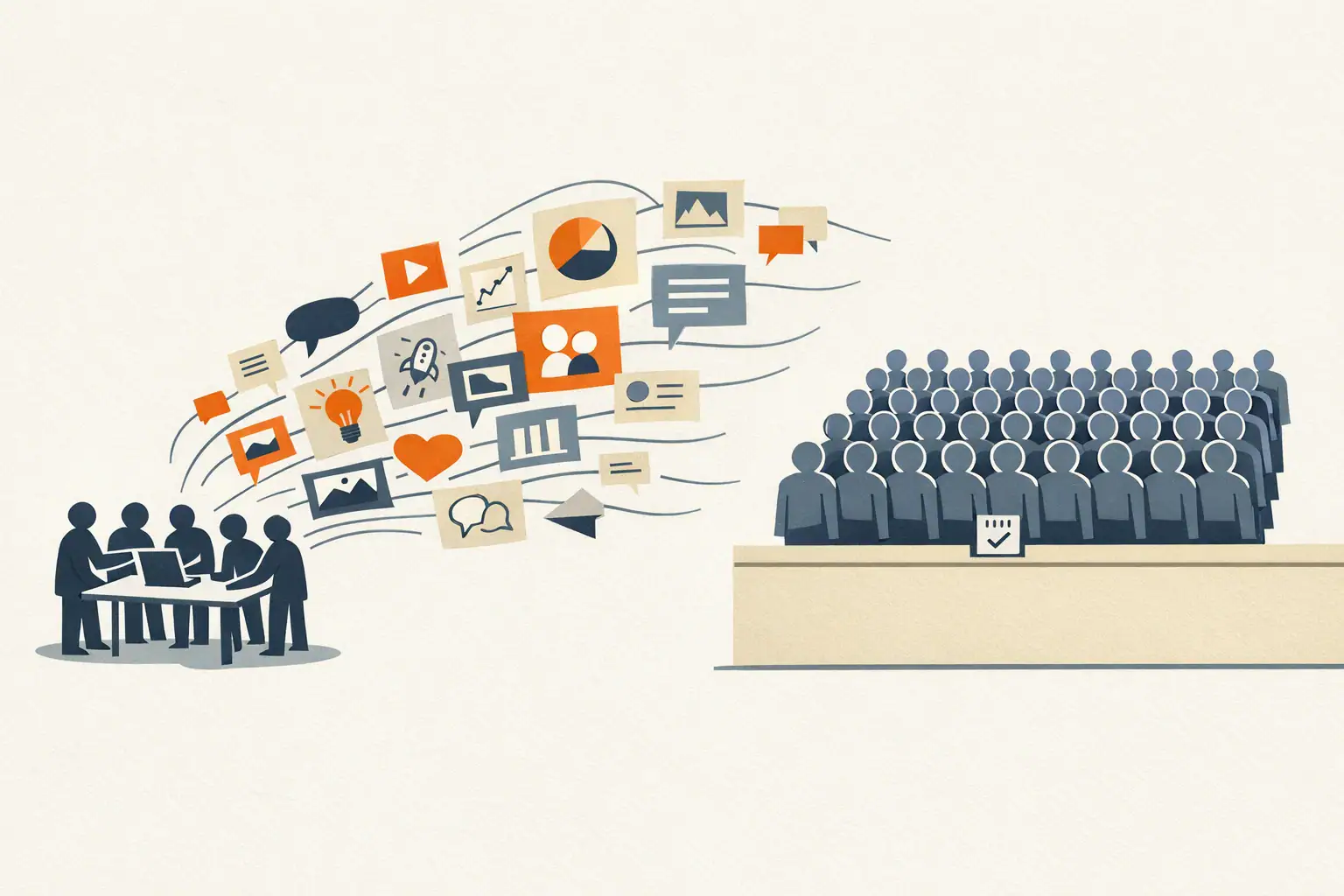
Short version: Duolingo doesn’t use AI to write their content. They use it to know what to write about. The creative output stays human. The research, synthesis, and timing layer is where AI earns its keep.
What we can see in the output
Watch their TikTok for a week and you’ll notice a few things. The Duo-owl content is reactive — specific moments, specific news cycles, specific trending sounds. It’s not calendar-planned in the usual sense. It’s emergent, riffing on things happening in the culture that day.
Second, the voice is unmistakably a voice. Not a brand voice. Not a committee voice. A voice. Whoever is running that account has a point of view, a sense of humor, and a specific relationship with the audience. You cannot generate that voice from a prompt. You can barely imitate it with a prompt.
Third, the posting cadence is relentless but the quality doesn’t collapse. That’s the real tell. Most brand accounts that post at that volume start repeating themselves, getting stale, or drifting into generic engagement-bait. Duolingo doesn’t. Something is feeding the team fresh angles faster than most teams can execute them.
What the team has said publicly
Zaria Parvez, the social media lead, has been explicit in interviews that the creative work stays human. She writes the posts. The team shoots the videos. The owl’s personality, such as it is, lives in humans’ heads, not a language model.
What they’ve said they use AI for, at least based on what’s public:
Trend-surfacing. Tools that monitor what’s going viral on each platform so the team can react before the moment passes. This is inference plus some public statements about monitoring — a common use of AI in social at their scale.
Audience research. Pulling together what the comment sections, reviews, and support tickets are saying into digestible summaries. The team has mentioned reading audience feedback as a primary creative input.
Localization support. Duolingo operates in dozens of languages and markets. Translating social content while preserving tone is famously hard, and there’s public evidence they use AI assistance for this layer (not for pure translation — their language content is meticulously vetted — but for adapting social posts and captions).
Asset production at the margins. Thumbnails, supporting image variants, mock-ups of physical things (like the Duo plushie promo content). Not the creative heart, but the polish around it.
What they’ve been clear they don’t use AI for: the actual tone of voice, the timing decisions, the reactive moments. Those stay with humans who have taste and reflexes the models don’t have yet.
The pattern, stated plainly

AI is upstream of the content. Humans are at the content. That’s the entire secret.
Most brands get this inverted. They try to use AI to write the posts themselves, while keeping the research and planning in human hands. The result: generic output, produced from specific research. Duolingo does the opposite. Specific output, produced from AI-accelerated research. The difference in what ships is enormous.
Three things to steal from this
1. Use AI to read, not to write. The highest-leverage use of AI in a social team is reading what the internet is saying faster than humans can. Comment sections, review threads, competitor posts, trending topics, emerging memes — all of this used to take a social manager several hours a day to skim. AI can summarize it in ten minutes. Use the saved hours on making.
2. Keep the creative voice in human hands. If your brand voice is worth anything, it came from a specific person or small group’s taste. That taste doesn’t compress well into a prompt. You can use AI as a first-draft engine, but the final voice pass should be human every time. Duolingo’s lead writes her own posts. That’s not a nostalgia move. It’s the thing that makes the account work.
3. Move at cultural speed, not campaign speed. Duolingo posts react to moments that are alive for 24 to 48 hours. Most brand social calendars are planned three to four weeks out. The teams that use AI well for social aren’t writing posts faster — they’re perceiving the cultural moment faster and then letting humans respond to it at speed.
What this means for a lean team
Most solo operators and small marketing teams don’t have a full-time social media lead with the taste to run a Duolingo-level account. That’s fine. The Duolingo pattern still applies, just scaled:
- Use AI to summarize what’s happening in your specific corner of the internet every morning — competitor posts, relevant reactions, trending topics in your niche.
- Write the actual posts yourself. Ten to fifteen minutes per post, with the context already loaded in your head from the AI-generated brief.
- Don’t try to automate the voice. That’s the thing people follow you for.
A solo founder who spends an hour a day on this pattern will outperform a team of three using AI to generate content and approve it. The math sounds wrong and it isn’t.
Where this breaks
The Duolingo model depends on having one person (or a very small team) with strong cultural instincts and the editorial freedom to act on them. If your company’s social posts need three-round legal and brand approval before they ship, you can’t move at cultural speed. No amount of AI will fix that structural problem.
If you’re in a regulated industry or a large enterprise, the adaptation is: move the AI-accelerated research layer in, but don’t try to replicate the reactive cadence. Use the time saved on research to do deeper, better-informed posts at a normal calendar cadence. That’s still a meaningful win.
The broader lesson
The brands winning at AI-assisted marketing in 2026 are the ones that figured out where the model is genuinely additive versus where it’s a substitute for the thing that makes their work work. Duolingo is an unusually clear example because the voice is so distinctive — you can’t miss the fact that it’s human because a model would never write it that way.
Most brands don’t have voices that distinctive, which is part of why their AI-generated social posts feel flat. The fix isn’t better prompts. The fix is developing a voice worth protecting, and then using AI to give that voice more reach and faster reflexes.
If you’re building the operator-side of an AI-native marketing team and want to see what the stack looks like end-to-end, here’s the two-person version. For the specific prompts I use in the research-layer work the Duolingo team does, those are here.
FAQ
Does Duolingo use AI to write their TikToks? No — based on public interviews with the team. The actual posts and video scripts are written by humans, specifically the social media lead. AI is used upstream: trend monitoring, audience research, localization support.
What is Duolingo’s social media strategy? Reactive, voice-driven, posted at cultural speed rather than campaign speed. One human with strong taste writes the content. AI accelerates the research and monitoring around the content, not the content itself.
Who runs Duolingo’s social media? Zaria Parvez has been the public face of the social team for several years, and the team has grown around her with other writers and producers. The structure is small and creative-led rather than process-led.
Can a small brand replicate Duolingo’s approach? Yes, partially. You can’t replicate the scale or the cultural heft of the Duo owl. But the underlying pattern — AI for research, humans for voice, react at cultural speed — scales down cleanly to a solo founder or a two-person team.
What tools does Duolingo use? The team hasn’t published a full stack. Public statements have mentioned native analytics, social monitoring tools, and AI assistance (without naming specific models) for research and localization layers.