


An AI marketing consultant helps a company turn AI tools into a working marketing system.
That sounds simple, but it’s where most teams get stuck. They try ChatGPT, buy a few tools, generate a few posts, maybe automate a handoff or two, and then the whole thing gets messy. The content starts to sound generic. The team doesn’t know which tool owns which step. Nobody trusts the drafts. Measurement is still disconnected from production.
The problem usually isn’t the model. It’s the operating system around the model.
That’s where AI marketing consulting can be useful. The work is less about “using AI” and more about deciding where AI belongs in the marketing process, where humans still need to make the call, and how to build repeatable workflows that a small team can actually use every week.
Quick answer: what an AI marketing consultant does
An AI marketing consultant helps with strategy, tool selection, workflow design, prompt systems, content operations, automation, measurement, and team training.
In practice, that usually means:
- Auditing the current marketing workflow
- Finding the repetitive work that AI can safely speed up
- Choosing the right tools for content, research, creative, analytics, and automation
- Building reusable workflows for campaigns, SEO, email, social, and reporting
- Creating prompt libraries and QA rules so output doesn’t sound generic
- Training the team to use AI without losing brand voice or strategic judgment
- Connecting AI output to measurable business goals
If you’re just looking for a list of tools, our complete AI marketing stack post is a better starting point.
If you’re trying to build an actual operating model, an AI marketing consultant should help answer a different question: what should your team stop doing manually, what should AI help with, and what should still stay human?
Why companies are hiring AI marketing consultants now
AI tools are easy to try and surprisingly hard to operationalize.
A founder can open ChatGPT and get a landing page draft in five minutes. A marketer can ask Claude for a campaign plan. A team can use an AI image generator to make social concepts. None of that automatically creates a reliable marketing engine.
The hard part is the layer around the tools:
- What information should the model get before it writes?
- Who approves the output?
- Where does customer research live?
- How do drafts move into WordPress, email, ads, or social?
- What should the team measure after the work ships?
- How do you keep AI from flattening the brand voice?
Companies hire AI marketing consultants when they want help turning scattered AI experiments into a process. For a small team, the goal is usually not to replace people. The goal is to let one or two strong operators produce the kind of output that used to require a much larger team.
That’s the operating model we wrote about in the 2-person AI marketing model post.
AI marketing consulting vs AI marketing services vs an AI marketing agency
These phrases overlap, but they’re not identical.
An AI marketing consultant usually helps design the system. They diagnose the current workflow, recommend tools, build the first version of the process, and help the team learn how to run it.
AI marketing services usually means ongoing execution. That can include SEO briefs, blog drafts, email campaigns, ad concepts, landing pages, reporting, or content repurposing.
An AI marketing agency usually combines strategy and execution with a larger delivery team. That can be useful if the company wants to outsource a meaningful chunk of marketing output, but it can also be more than a lean team needs. We covered the build-versus-hire question in more depth in our AI automation agency vs Hermes Agent piece.
The right choice depends on the bottleneck. If the bottleneck is “we don’t know what to build,” start with consulting. If the bottleneck is “we know what to do but we can’t produce enough,” services or agency support may make more sense.
What the first 30 days should include
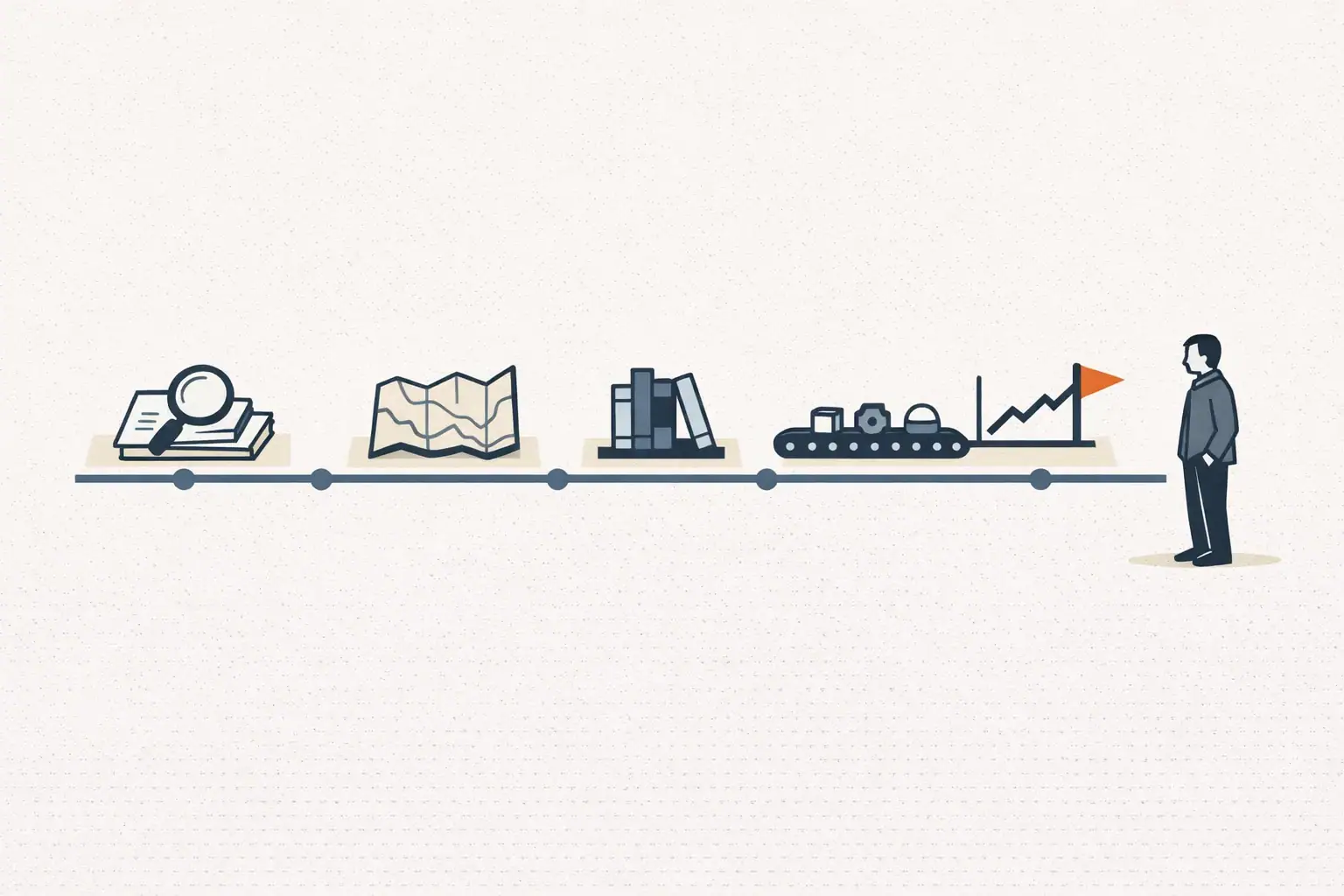
A good first month isn’t a tool shopping spree.
It should start with a workflow audit. Where does marketing work begin? Who writes the brief? Where does customer language come from? How are posts, emails, ads, or landing pages approved? What happens after something ships?
From there, the consultant should map the work into a simple operating system:
- Inputs: customer interviews, sales calls, analytics, search data, competitor research
- Production: briefs, drafts, creative concepts, repurposing, channel formatting
- Review: brand voice, claims, legal risk, factual accuracy, offer fit
- Distribution: WordPress, email, LinkedIn, paid social, CRM, sales enablement
- Measurement: Search Console, analytics, CRM notes, campaign performance
Google Search Central is still the baseline for understanding how content should be structured for search. For measurement, most teams should at least have Google Analytics and Google Search Console set up before they start publishing heavily.
AI can speed up the production layer, but the surrounding system matters more. Without the system, the team just makes mediocre content faster.
Workflows an AI marketing consultant usually builds
The highest-value workflows are usually boring. That’s a compliment.
A useful consultant should help build repeatable workflows like:
- A weekly customer-research synthesis from sales notes, support threads, and call transcripts
- SEO brief generation from keyword data, SERP review, and internal expertise
- Blog drafting with a real outline, examples, links, and editorial guardrails
- Email newsletter drafts based on the company’s recent work, offers, and customer questions
- Social repurposing from long-form articles and founder notes
- Landing page variant generation for different audiences
- Competitive teardown briefs that sales and marketing can both use
- Reporting summaries that explain what changed and what to do next
This is where tools like ChatGPT, Claude, HubSpot, Google Workspace, Airtable, Zapier, Make, and WordPress fit together. OpenAI has business resources here and Anthropic’s enterprise offering covers Claude for work. For a deeper look at the specific recurring workflows worth building first, our piece on the five AI agents every marketer should build covers the highest-leverage ones.
The tool list changes quickly. The workflow logic doesn’t.
What AI should not do in your marketing
AI shouldn’t own your positioning. It shouldn’t invent customer claims. It shouldn’t decide what your company believes. It shouldn’t publish without review. It shouldn’t turn every piece of content into the same safe, forgettable essay.
The best AI marketing systems keep humans close to the decisions that matter:
- Who the customer is
- What pain is worth solving
- Which claims are true
- Which examples feel real
- What the company should be known for
- What should be cut because it sounds like everyone else
AI is excellent at expansion, variation, summarization, and first drafts. It’s weaker at taste, judgment, and responsibility. A good consultant should make that boundary explicit.
For more on which model to use for which job, our piece on Claude vs ChatGPT for marketing breaks down the trade-offs.
How to know whether you need a consultant
You probably don’t need an AI marketing consultant if your team already has a clear strategy, strong operating docs, good QA, clean reporting, and a working content engine.
You might need one if:
- Your team has tried AI, but the results are inconsistent
- You have too many tools and no workflow
- Your content sounds generic when AI touches it
- You want to publish more, but don’t want to lower the bar
- Your marketers are spending hours on repetitive formatting, research, and repurposing
- Your founder or subject-matter experts have good ideas that never become content
- You want an AI-assisted system that your current team can actually maintain
That’s the kind of work we help companies think through on our services page.
Questions to ask before hiring an AI marketing consultant
Before hiring anyone, ask practical questions:
- What workflows would you build first for a company like ours?
- How do you prevent AI content from sounding generic?
- How do you handle factual review and source checking?
- Which tools do you recommend, and why?
- What should stay manual?
- How will the team use the system after you leave?
- What will we be able to produce in 30, 60, and 90 days?
The answers should be specific. If every answer sounds like “use AI to scale content,” keep looking. If you want a sense of what good looks like before the conversation, our piece on how to use ChatGPT for marketing lays out an actual operating model.
The point isn’t more AI. It’s a better marketing system.
Most companies don’t need more experiments. They need a repeatable way to turn customer insight into useful marketing.
AI can help with that, but only if the process is designed on purpose. The consultant’s job is to make the work clearer, faster, and easier to trust.
If your team has scattered AI experiments and wants to turn them into a working marketing system, get in touch here.


