Most marketing org charts were drawn for a world where humans wrote everything by hand. Two people on content. Three on creative production. Two on paid. Two on lifecycle. One on analytics. One on brand. A director above all of them. Maybe a content lead, maybe a coordinator. By the time you’ve drawn the boxes you’re at twelve people and a $1.6M annual run rate before you’ve shipped anything.
The AI-native version of that team is two people plus tools. I’ve built and run this model with multiple clients over the last eighteen months, and the pattern is consistent enough now to write down.
This post is the operator companion to the 2-person stack that does the work of 20. That post covered which tools. This one covers who runs them, how the week is organized, and where the model breaks.
The two roles
The team is two people. They specialize.
Role 1: The Operator. Owns strategy, voice, taste, and the customer conversation. Writes the briefs, makes the editorial calls, talks to actual customers, decides what ships. The hire profile is a senior generalist with strong taste, the kind of person who would have been a marketing director or a head of content at a traditional company. They’re paid like a director ($150-200k base). Not an executor by nature, but fluent enough with the AI tools to direct them with confidence.
Role 2: The Producer. Owns execution, volume, and the production calendar. Turns briefs into shipped assets: blog posts, ad variants, email flows, landing pages, video cuts, social posts. The hire profile is a fast, AI-native operator who treats the tools like an extension of their hands. They’re typically 2-5 years into their career, paid $80-120k. Strong opinions about workflow, less interested in strategy debates.
Both people can write, both can think strategically, both can use the tools. But they specialize. The Operator is upstream of the Producer in roughly 80% of the work.
The weekly operating calendar

Here’s what an average week looks like. This isn’t aspirational. It’s the rhythm I’ve watched work across multiple engagements.
Monday. Operator reads last week’s analytics and customer signal, decides the week’s priority, writes 2-3 briefs. Producer reviews the briefs and asks clarifying questions. Both align on what ships by Friday.
Tuesday-Wednesday. Producer is in flow state, executing against the briefs. Long-form content, ad variants, email sequences, image prompts. Operator is in customer mode: calls, interviews, sales support, partner conversations. They sync at end-of-day for 15 minutes.
Thursday. Producer finishes execution and queues everything for review. Operator reviews, edits, approves. Anything that doesn’t pass the voice check goes back, and the Producer fixes it same-day. Anything that does pass gets scheduled.
Friday. Half-day on measurement. Operator looks at last week’s performance against goals. Producer cleans up the production system, archives drafts, preps next week’s calendar. The second half is R&D: testing a new tool, prompting a new format, watching what competitors are shipping.
That’s the whole rhythm. Five days, two people, roughly 60 person-hours of total work, against output that would take a 10-12 person traditional team a week and a half.
How the work splits
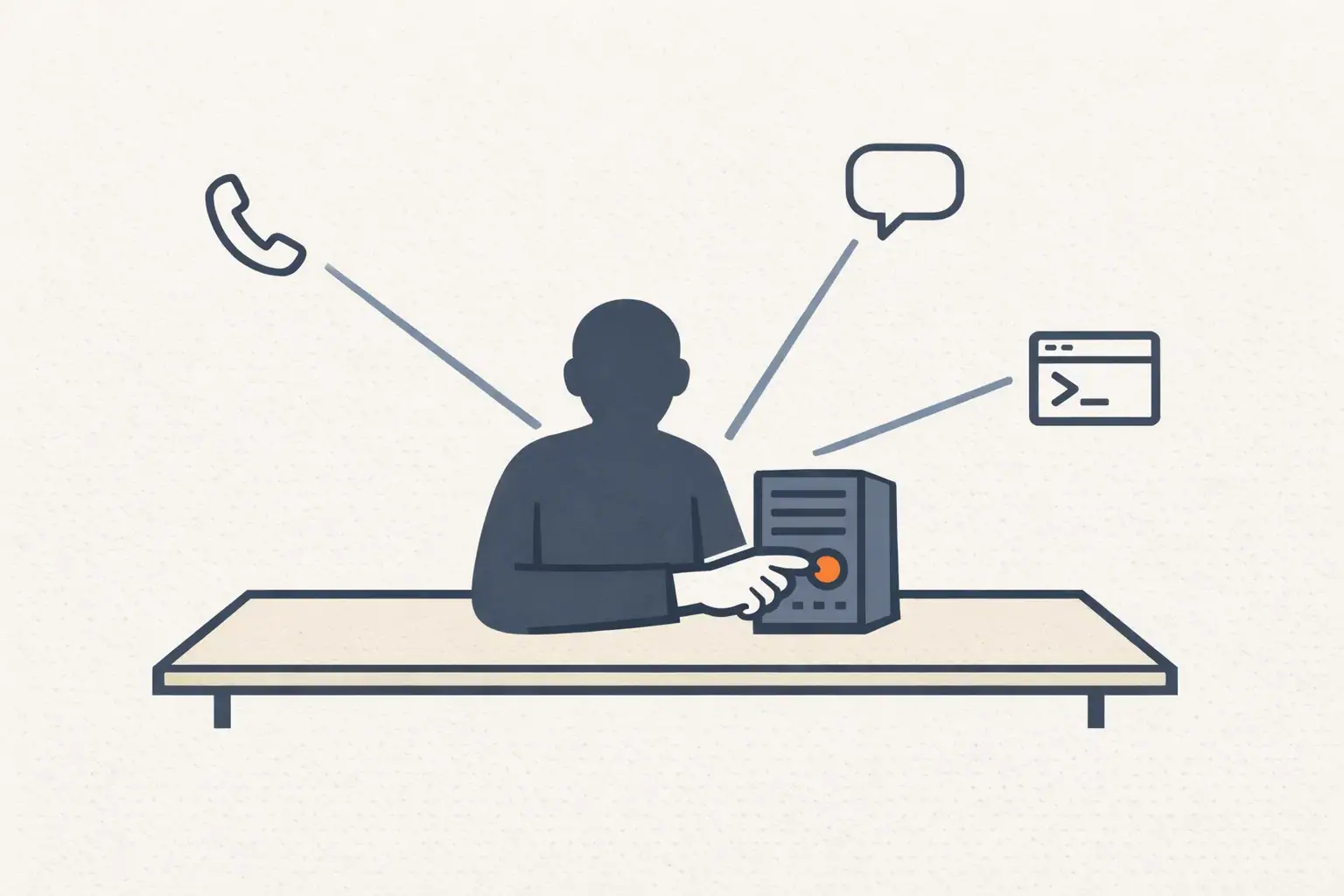
The clean way to think about it: strategy lives upstream, execution lives downstream, and the AI tools sit in the middle holding the context.
The Operator generates the upstream artifacts — briefs, voice docs, positioning, customer truth. Those get loaded into Claude Projects or Custom GPTs that the Producer uses as the working context. The Producer never starts from scratch. Every output is downstream of an Operator-written brief that the AI tool already understands.
This is the part most teams miss. The tools don’t replace either person. They sit between the two, holding the context that used to require constant back-and-forth in Slack: eight messages a day instead of forty.
What each person actually owns
The Operator owns brand voice and editorial standards, strategic memos and quarterly planning, customer conversations, all Claude Projects (voice docs, brief templates, positioning), final approval on anything published, and hiring decisions when the team grows.
The Producer owns the production calendar and asset queue, all Custom GPTs and tactical workflows, image generation, video, and ad variants, distribution mechanics (scheduling, posting, list hygiene), the first draft of everything, and tool-stack maintenance.
The overlap is real but small. Both can write a blog post in a pinch. Both can interpret analytics. Both speak fluent prompting. The specialization is about who defaults to which work.
What this team can ship in a normal week
I’ve seen these teams produce, on an average week:
- 1-2 long-form blog posts (1,200-2,000 words each)
- 4-6 LinkedIn posts in founder voice, distribution-ready
- 1 email newsletter or campaign
- 8-12 ad variants for paid campaigns
- 1-2 customer interviews completed and synthesized
- 1-2 hours of recorded video, with talking-head and b-roll cuts
- A weekly performance dashboard with written narrative
That’s a normal week. A heavy week, like a product launch or a big campaign, pushes 50-70% more. A light week (recovery or planning) drops to maybe 60%. Across a quarter it averages out.
The traditional comp for this output is a content team of four, an ads team of two, a designer, a video editor, a marketing ops coordinator, and a director sitting above all of them. That’s roughly eleven people. The AI-native version gets the same throughput with two.
Hiring criteria
The biggest mistake I see is hiring for the org chart you wish you had instead of the one this model actually needs.
For the Operator role, the bar is taste and judgment. Past titles matter less than work samples. Read their writing, look at their past campaigns, ask what they killed and why. They should be comfortable saying “this isn’t good enough” without flinching. AI fluency is required but doesn’t separate the strong candidates from the average ones.
For the Producer role, the bar is speed and tool fluency. Show me their setup. What’s in their tab bar. How they prompt. How long it takes them to produce an ad set. What separates the strong candidates from the average ones is having opinions about workflow. They’ve already built systems before, they know what’s slow, and they ship.
Both should be hired for retention. This model only works if the two people stay together for at least 18 months, because the compounding only kicks in after 6-9 months of shared context. The Operator’s voice docs are deeper, the Producer’s prompt library is sharper, the team’s shared shorthand is faster. Replacing either person resets a meaningful chunk of that.
Where this breaks
Three honest failure modes I’ve watched.
The Operator hires for executor skills. Someone who can write a brief but won’t trust the Producer to execute on it. The Operator drifts into doing both jobs, burns out, and the team’s throughput drops to whatever one tired person can produce.
The Producer hires for taste. Someone who pushes back on briefs, wants strategy input on every piece, slows the production calendar. Throughput drops, and the team starts to feel like two people doing the work of one and a half.
Either person without strong AI fluency on day one. This is not a “we’ll learn the tools as we go” model. Both people need to be at least intermediate with Claude, ChatGPT, and one image tool from day one. If they aren’t, the operating rhythm collapses back to traditional execution speed and now you’ve got two expensive generalists instead of a high-leverage team.
When you need a third hire
The team scales surprisingly well. I’ve watched this model handle marketing for companies producing $5-15M in marketing-attributable revenue without breaking. The trigger for a third hire is specialization depth. Volume alone won’t do it.
Add a third person when one of these is true:
- You’re running paid media at a level that needs daily optimization (typically $30k+/month in spend), and neither current person has the bandwidth to live in the ad accounts
- You’re producing video at a volume where editing becomes the bottleneck (multiple finished pieces per week)
- You’ve expanded into a second motion (outbound sales partnership, channel marketing, community) that needs dedicated content
The third hire is almost always a specialist. Paid media ops, video editor, or outbound content. The two original roles stay in place.
The bigger framing
Calling this “doing more with less” misses what’s actually happening. The team is structured differently from the start. The work, the rhythm, and the org chart are all shaped around small headcount and high tooling leverage, instead of being a shrunk-down version of a traditional department.
The teams I’ve seen succeed with this approach didn’t shrink a traditional department down. They started here, hired for it, and let the AI tools do the work that headcount used to do. The teams that struggle with it tried to bolt AI onto a traditional structure and ended up with twelve people using ChatGPT.
If you’re early enough to design the team this way from scratch, design it this way. If you already have a traditional marketing department and want to migrate toward this model, the path is real but slower. That’s a separate conversation, and a separate post.
The companion read on the tools that make this team possible is the complete 2026 AI marketing stack. For tactical prompts the Operator and Producer both lean on, the seven AI marketing prompts I use weekly is the starting library.
Work with us
If you’re building a marketing team this way, or trying to get an existing team to operate this way, that’s what we help companies do. We take on a small number of engagements per year.