

A lot of small businesses hit the same wall with AI around month three.
They’ve used ChatGPT for copy, emails, ideas, maybe a few spreadsheets. It helped, but the business runs the same way it did before. The next obvious step is repeatable workflows: research the market every Monday, draft a blog post from a keyword brief, summarize customer questions, prepare sales follow-up, send a report to the team. That’s the moment people start Googling “AI automation agency,” “AI workflow automation,” and “AI agents for business.”
There are two basic paths.
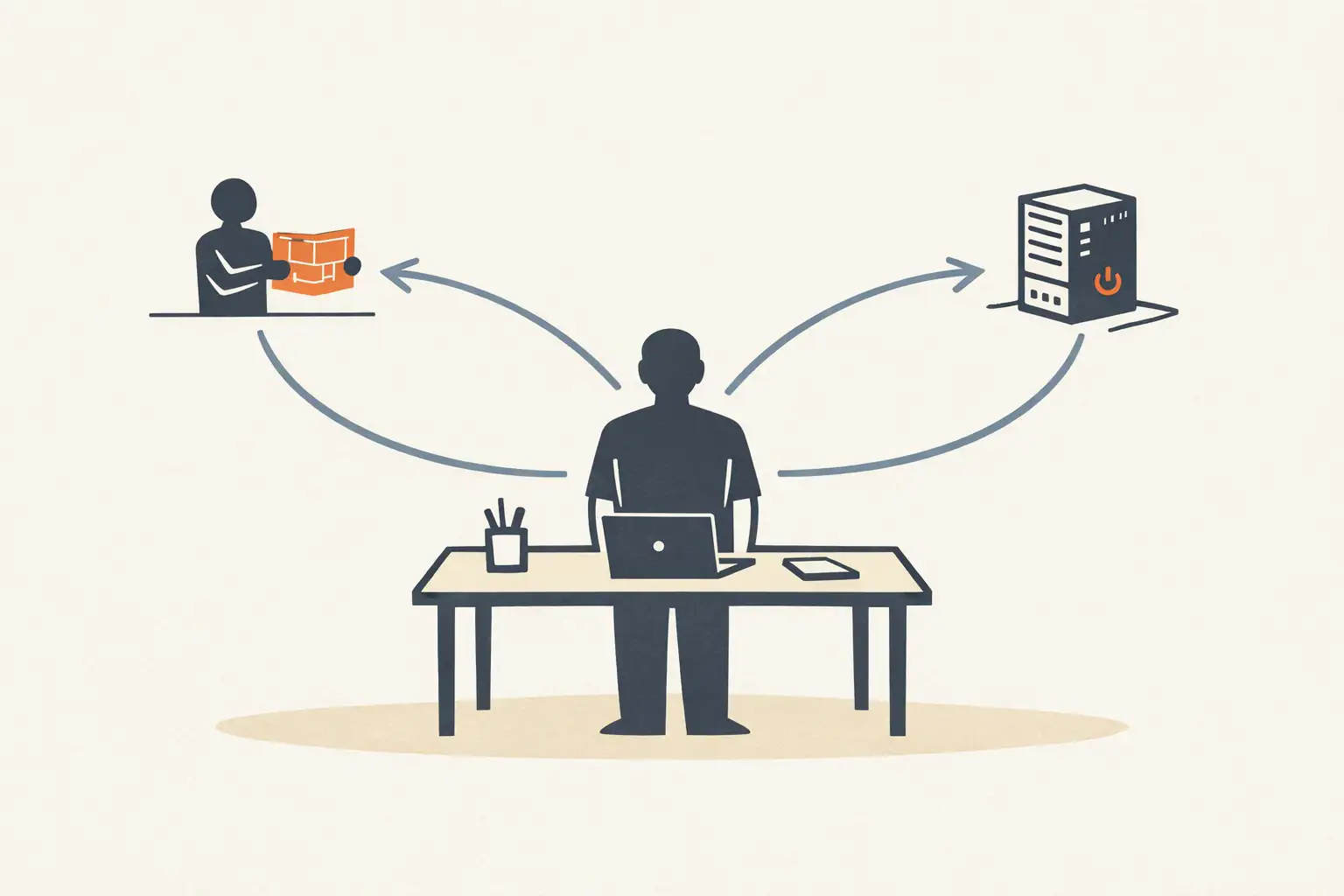
You can hire an AI automation agency or consultant to design the system for you. Or you can build more of it yourself with an open-source AI agent framework like Hermes Agent.
For most small businesses, the right answer is neither one in isolation. The best setup is a practical middle ground: use a flexible agent like Hermes for the work, then use consulting help to decide what should be automated, how the workflows should be controlled, and how the system fits into your marketing and operations. Buying “AI automation” is easy. Building something your team actually uses is the hard part.
What an AI automation agency actually does
An AI automation agency connects AI models to recurring work. That covers marketing workflows, sales operations, customer service, reporting, internal documentation, lead routing, CRM updates, and content production.
The work usually breaks into a few buckets:
- Finding repeatable tasks worth automating
- Choosing the right tools and models
- Connecting apps like Google Workspace, Slack, WordPress, HubSpot, Airtable, or your CRM
- Writing prompts, instructions, and review steps
- Setting up safeguards so the AI doesn’t publish, email, delete, or modify sensitive data without approval
- Training the team on what the system can and cannot do
That last one is where most projects succeed or fail. The hard part is rarely getting an AI model to generate text. It’s turning messy human work into a workflow that has inputs, outputs, owners, checks, and a clear reason to exist.
For the broader view of how this changes marketing teams, see our 2-person AI stack piece. The principle applies here: AI doesn’t remove the need for operators. It changes what a small team can produce when the operating model is clear.
Where Hermes Agent fits
Hermes Agent is an open-source AI agent from Nous Research. It runs in a terminal and, when the gateway is configured, through messaging platforms like Telegram, Discord, Slack, WhatsApp, Signal, Matrix, and email.
The shorthand is simple: a chatbot answers, an agent does.
Hermes can use tools. Depending on how you configure it, it can search the web, read and write files, run terminal commands, inspect a codebase, schedule recurring jobs, send messages, run browser automation, work with Google Workspace, and remember reusable procedures through skills.
That makes it different from a normal AI chat window. A chat window can help you think through a blog post. Hermes can research the keyword, scan your site for internal links, draft the article, save it to a file, zip the handoff pack, and send it to the right place.
For the full setup walkthrough, we have a separate Hermes Agent setup guide. This article is about the business decision: when does a small business want an open-source AI agent, and when does hiring an AI automation consultant still make sense?
Why small businesses get stuck after the first AI experiments
Most small businesses don’t fail with AI because the tools are weak. They fail because the use case is vague.
“Use AI for marketing” is not a workflow.
“Every Monday, generate a competitor content brief from these five sites, compare it to our published blog archive, identify three content gaps, and draft one WordPress-ready article outline” is a workflow.
That’s the difference between playing with AI and operating with AI.
If your team is still at the prompt stage, our list of AI marketing prompts I actually use every week is a good starting point. Prompts are useful. The next step is packaging the best ones into repeatable systems that run the same way every time.
Hermes is good at that second step because it can combine prompts with tools, files, memory, and scheduled work. Instead of relying on a person to remember every step, you create a workflow the agent follows.
The build-versus-hire question
A small business usually asks a version of this:
Should we hire an AI automation agency, or should we use tools like Hermes Agent ourselves?
Honest answer:
If you already know the workflow, have someone technical enough to maintain it, and can tolerate some setup work, Hermes Agent gives you a lot of leverage. It’s open source, flexible, and not locked into one AI provider. You can use OpenRouter, OpenAI, Anthropic, Google Gemini, DeepSeek, or local models depending on your needs.
If you don’t know which workflows matter, if the work touches customers or revenue, or if your team won’t maintain the system, hiring help is usually cheaper than wandering around for three months. The expensive part isn’t the software. It’s the operating confusion.
An AI automation consultant should help you answer questions like:
- Which workflows are worth automating first?
- What should stay human-reviewed?
- Where should AI draft versus decide?
- Which systems should be connected now, and which should stay manual?
- How will the team know whether the automation is working?
- Who owns failures, approvals, and updates?
The best projects often combine both. Use Hermes Agent as the flexible execution layer. Use consulting help to design the workflow and avoid expensive mistakes.
What Hermes can automate for marketing
Marketing is often the best first area for AI workflow automation because the work is repetitive, research-heavy, and easy to review before it goes public.
A Hermes-based marketing workflow might handle:
- Keyword research and SEO prioritization
- Competitor content scans
- Blog brief creation
- Drafting and repurposing content
- Finding internal links from your live site
- Preparing social posts from published articles
- Summarizing performance data
- Building weekly content calendars
- Turning customer questions into FAQ ideas
We already covered the depth on this in Hermes Agent for marketing automation. The point worth keeping here: Hermes is especially useful when the work crosses multiple steps.
A normal AI tool might write a draft. Hermes can do the pre-work and post-work around the draft: research the query, inspect the existing site, preserve external links, save the files, and prepare the handoff for a human editor. That’s where agents start to feel different from chatbots.
What Hermes can automate for customer service and operations
Customer service is another practical place to start, especially for businesses that get the same questions repeatedly.
Hermes can help turn customer conversations into usable assets:
- FAQ pages
- Support macros
- Knowledge base drafts
- Internal training documents
- Customer response templates
- Bug or complaint summaries
- Monthly voice-of-customer reports
The agent shouldn’t be given unlimited authority to handle sensitive customer issues alone. That’s a bad first automation. But it can help your team process, summarize, draft, and organize customer service work.
For a deeper look, see our guide to Hermes Agent as an AI customer service and operations assistant.
The best early customer-service workflows keep a person in the loop. Hermes drafts. A human approves. The system gets faster without pretending support is fully solved.
Five AI agent use cases worth building first

If you’re trying to decide what to automate first, start with work that’s frequent, low-risk, and reviewable.
1. The weekly content brief agent
This agent scans a keyword list, checks existing content, reviews competitor pages, and creates a brief for one new article.
Inputs:
- Target keyword
- Competitor URLs
- Existing blog sitemap
- Product or service notes
Outputs:
- SEO title
- Meta description
- Suggested slug
- Internal link targets
- External source links
- Article outline
- Draft handoff prompt
Strong first workflow because the output is easy to review. Nothing is published automatically.
2. The internal link finder
Internal links are one of the most annoying parts of blog production. They’re also one of the easiest things for an agent to help with.
Hermes can scan a sitemap, collect live URLs, read page titles and headings, and suggest where a new article should link. That makes the editor’s job easier and helps the site build topical authority.
This article, for example, naturally links to our posts on the complete AI marketing stack, 5 AI agents every marketer should build, and 12 ChatGPT marketing use cases because the topics actually overlap. The agent can find those connections faster than a human can.
3. The customer voice synthesizer
Reviews calls, emails, reviews, survey responses, or support tickets and extracts repeated customer language.
Outputs typically include:
- Common objections
- Phrases customers use to describe the problem
- Questions that should become FAQ sections
- Content ideas based on real customer confusion
- Sales copy angles that match the customer’s words
Connects directly to content and conversion work. Also keeps AI copy from sounding like a generic template.
4. The campaign repurposing agent
A small team often publishes one good asset and then fails to turn it into enough supporting material.
A repurposing agent can take a blog post and produce:
- LinkedIn post drafts
- X/Twitter post drafts
- Email newsletter angles
- Short video talking points
- Sales follow-up snippets
- Internal talking points for the team
Pairs well with the operating model in our piece on marketing team structure in a 2-person AI model.
5. The weekly executive summary agent
A founder or operator doesn’t need another dashboard. They need a short summary of what changed and what to do next.
Hermes can prepare weekly summaries from analytics exports, Search Console notes, CRM updates, support themes, and project notes. The result should be short enough to read and specific enough to act on.
The agent shouldn’t invent performance numbers. It should cite the source data and flag missing inputs.
Why open source matters here
Open source isn’t automatically better for every business. With AI agents, it has real advantages.
An open-source AI agent like Hermes gives you more control over:
- Where the agent runs
- Which model provider it uses
- Which tools it can access
- What workflows are saved as reusable skills
- Whether the system lives on a local machine, a VPS, or a private server
That flexibility matters because AI automation is rarely one-size-fits-all. A local service business, an ecommerce brand, a B2B consultant, and a nonprofit may all want AI workflows, but the systems they need to touch are different.
Hermes can run on Linux, macOS, or WSL. For server deployments, businesses often use a VPS from providers like DigitalOcean, Hetzner, Vultr, Linode/Akamai, AWS Lightsail, or Hostinger VPS. Secure remote access can be handled with Tailscale or Cloudflare Tunnel.
None of that means every small business should self-host everything. It means the option exists. For teams with security, privacy, or workflow-control concerns, that option can matter.
What not to automate first
The fastest way to ruin an AI automation project is to start with the riskiest workflow.
Don’t begin with:
- Fully automated customer replies for sensitive issues
- Unreviewed legal, medical, or financial advice
- Auto-publishing content without editorial review
- CRM changes that can affect active deals
- Bulk outbound email without human approval
- Anything that deletes, refunds, cancels, or changes customer data
Start with drafting, research, summarization, reporting, internal routing, and handoff preparation. These workflows create leverage without handing over the keys.
Good AI systems don’t pretend humans are unnecessary. They make humans faster at the parts where judgment matters.
A simple framework for choosing your first AI workflow
Use this filter before you hire an AI automation agency or build with Hermes yourself.
Is the task frequent? If it happens once a quarter, probably not worth automating yet. Every week is a much better candidate.
Is the output reviewable? A blog brief, customer summary, or report draft is easy to check. A hidden database update is harder to trust.
Are the inputs clear? The agent needs a reliable starting point: a folder, spreadsheet, website, CRM export, sitemap, transcript, or list of URLs.
Does the workflow save real time? Some automations are impressive but useless. The first workflow should remove a real bottleneck.
Can the team explain the workflow in plain English? If nobody can describe the workflow, the automation will be fragile. Write the human version first. Then automate parts of it.
This is also where our piece on Claude vs ChatGPT for marketing is relevant. The model matters, but the workflow matters more. The best model in the wrong operating system still produces mediocre work.
The role of an AI automation consultant
A good AI automation consultant shouldn’t just sell tools. They should help you build the operating system around the tools.
That includes:
- Workflow selection
- Prompt and instruction design
- Tool access rules
- Human approval points
- Documentation
- Training
- Measurement
- Maintenance
For many companies, that’s the missing layer. They don’t need more random AI tools. They need a smaller number of workflows that run reliably.
If the main need is marketing, start with our piece on how to use ChatGPT for marketing and our complete 2026 AI marketing stack post. Then decide which parts should become agentic workflows.
What a Hermes Agent implementation can look like
A simple Hermes implementation for a small business:
- Install Hermes on a local machine or VPS.
- Connect a model provider such as OpenRouter, Anthropic, OpenAI, Gemini, or another supported one.
- Enable only the tools the workflow needs.
- Create a few repeatable skills for common tasks.
- Add a messaging interface if the team wants to use it from Telegram or Slack.
- Create a weekly scheduled job for reporting, research, or content prep.
- Keep publishing, sending, and customer-facing actions human-approved.
The official Hermes Agent documentation covers installation, configuration, tools, gateways, skills, and cron jobs. The GitHub repository is the right place to inspect the project directly.
If the business uses WordPress, Hermes can help prepare content for a human editor. The WordPress REST API can also be part of a more advanced workflow, though auto-publishing should usually come later. Start with draft preparation, not direct publishing.
Security and governance are part of the project
AI workflow automation touches real business data, so security can’t be an afterthought.
At minimum, businesses should think through:
- Which accounts the agent can access
- Which files it can read and write
- Which tools it can call
- Which actions require approval
- Where API keys and tokens are stored
- How errors are logged
- Who reviews outputs before customers see them
Useful references: the NIST AI Risk Management Framework, the FTC’s business guidance on AI, and GitHub’s secret scanning documentation. Not exciting reading, but they matter.
The short version: don’t give an agent broad access until you know what it does with narrow access.
When to hire help
Hire help if any of these are true:
- You know AI could help, but you don’t know where to start.
- Your first workflows touch customers, revenue, or private data.
- You need the system to connect multiple tools.
- Your team has tried prompts but failed to turn them into routines.
- You want an AI operating model, not just a list of tools.
- You need someone to decide what not to automate.
Build more internally if:
- You have a technical operator who likes this work.
- Your first workflows are low-risk and internal.
- You already have clear process documentation.
- You can review outputs before they affect customers.
- You want to own the system long term.
Most small businesses should do both. Get help designing the first few workflows, then keep the system simple enough that the internal team can run it every week.
The practical takeaway
An AI automation agency can help you build the system. Hermes Agent can help run the work. The mistake is treating either one as magic.
Small businesses don’t need a giant AI transformation program. They need a few reliable workflows that remove repetitive work from a lean team.
Start with one workflow. Make the inputs clear. Keep the output reviewable. Add human approval where it matters. Document what works. Then build the next one.
That’s how AI stops being a novelty and starts becoming an operating advantage.
If your business wants help designing that kind of workflow, our services page explains how we work. You can get in touch here.


