

Most “ChatGPT for SEO” content is written like SEO is dead and ChatGPT is the funeral.
The reality is more boring and more useful. ChatGPT didn’t kill SEO. It made certain parts of the SEO workflow much faster, certain parts much worse, and added a new layer (LLM citation tracking) that didn’t exist two years ago. Operators who use ChatGPT well still rank in Google. Operators who use it badly produce slop that doesn’t rank anywhere.
This post is the working ChatGPT for SEO workflow we run on ravitz.co. The specific steps where ChatGPT adds leverage, the steps where it hurts, the prompts we use, and the part the SEO discourse is mostly missing in 2026.
For the broader pipeline this slots into, our SEO automation post is the end-to-end workflow. This piece zooms in on the ChatGPT-specific layer.
What ChatGPT is actually good at in SEO
Six things in the SEO workflow where ChatGPT meaningfully cuts time:
Keyword brainstorming. Generating 20-50 candidate keywords around a seed topic for a specific ICP. Faster than starting cold in Ahrefs.
Search intent classification. Reading a SERP and telling you whether the intent is informational, commercial, transactional, or navigational. Saves the click-through-the-top-10 step.
Outline generation. Drafting a working H2/H3 outline from a target keyword + a sketch of the SERP angle. Better than starting from a blank page.
Meta description writing. Producing 5-10 meta description variants per page. Fast, format-aware, and the variants improve the team’s eye for what works.
Schema markup drafting. Generating JSON-LD for FAQ schema, Article schema, HowTo schema. Templated work that doesn’t require human creativity.
Content brief synthesis. Turning competitive SERP data into a brief that tells the writer what the page needs to cover.
For the prompts that drive these specific steps, our 30 ChatGPT prompts for marketers post has prompts 13-17 covering the full SEO layer.
What ChatGPT is bad at in SEO

Five things ChatGPT actively makes worse in the SEO workflow:
Volume and difficulty data. ChatGPT doesn’t have current ranking data. Numbers it gives are either guesses or stale. Use Ahrefs, Semrush, or Keywords Everywhere for actual data.
SERP reading. ChatGPT can read URLs but its analysis of what’s ranking is shallow. The browser-based version is better, but for serious SERP analysis you want to be looking at the SERP yourself or using Ahrefs’ SERP overview.
Final draft writing. First drafts: useful. Final drafts: a brand-voice erosion risk. The humanizer audit we wrote about in our SEO automation post catches the AI-slop patterns that hurt rankings and trust.
Backlink strategy. ChatGPT will produce plausible-sounding backlink ideas. Most are stale or imaginary. Real link prospecting needs current data and human outreach judgment.
Technical SEO audits. ChatGPT can read documentation about technical SEO. It can’t actually crawl your site, check robots.txt against live state, or validate Core Web Vitals. Use Screaming Frog or Ahrefs Site Audit for the real work.
The pattern: ChatGPT is good at language synthesis, bad at quantitative data and real-world site state. Use it for the former, use other tools for the latter.
The ChatGPT for SEO workflow we run
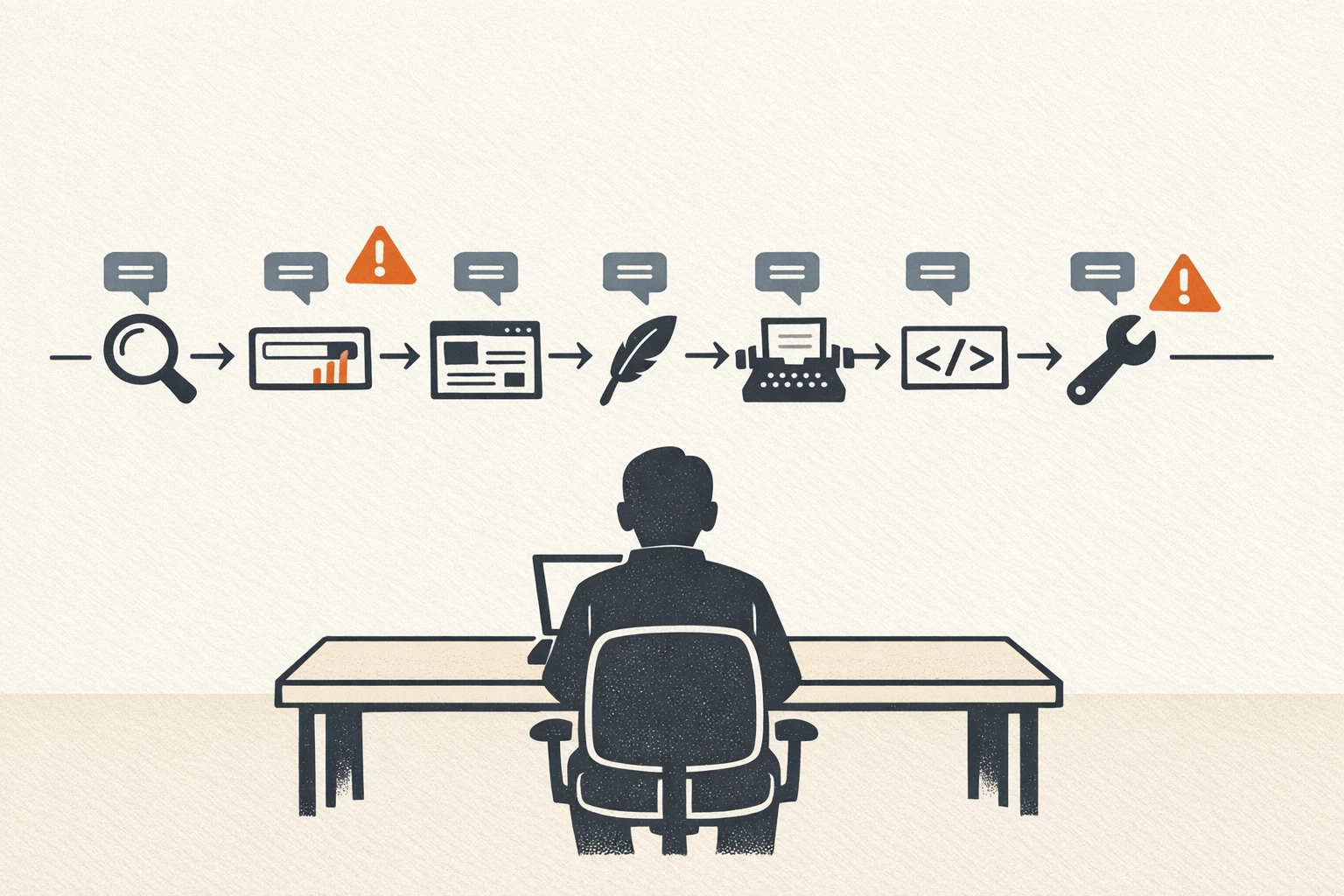
Seven steps. We use ChatGPT in five of them and explicitly avoid using it in the other two.
Step 1: keyword brainstorming (ChatGPT)
Start with a seed topic and an ICP. Run this prompt:
You are helping a marketer at [company, briefly described] do keywordresearch for the [topic] cluster. The ICP is [audience description].The site's current domain authority is [DR].Generate 30 candidate keywords. Group them into:- Long-tail (3+ words, specific intent, lower volume)- Mid-tail (2-3 words, mixed intent, moderate volume)- Head terms (1-2 words, broad intent, high volume)For a [DR] site, mark which long-tail keywords are realistically rankablein the next 6 months versus which need DR growth first.Do not include keyword volume or difficulty numbers. Those will bepulled from Ahrefs separately.Topic: [paste]
The “do not include volume/difficulty” constraint matters. ChatGPT will guess otherwise and the guesses are wrong often enough that they pollute the planning.
Step 2: keyword data validation (Ahrefs, not ChatGPT)
Take the 30 candidates from step 1. Run them through Ahrefs Keywords Explorer for actual volume, KD, and CPC. This is where you separate the candidates worth pursuing from the ones that sound good but have no real demand.
Filter for: volume ≥100 (anything under is too thin to bother), KD ≤ [your DR threshold] (≤20 for a DR 0 site, higher as DR grows), and CPC > $0 (shows commercial intent).
Skipping this step is the most common ChatGPT-for-SEO mistake. You end up writing for keywords nobody searches.
Step 3: SERP analysis (ChatGPT-assisted)
For each shortlisted keyword, look at the top 10 SERP results. Use Ahrefs SERP overview for the data layer (DRs, backlink counts, traffic estimates). Then run this prompt to extract the intent signal:
Below are the top 10 results for the keyword "[keyword]" (URLs and titles).Tell me:- The dominant content format (listicle, how-to, comparison, product page, video, tool)- The questions all 5 of the top 5 answer well- The 2 questions none of them answer that the searcher likely has- The angle a new entrant could take that nobody is takingResults:[paste]
Step 3 is where the angle of the article gets decided. The two unanswered questions plus the new angle are the differentiation play.
Step 4: outline generation (ChatGPT)
With the keyword data and SERP intent locked, generate the outline:
Write an H2/H3 outline for a blog post targeting "[keyword]". The readeris [audience]. The angle is [angle from step 3]. The goal is [conversion].The outline should:- Cover what the SERP requires to rank (the 5 questions in step 3)- Include 2 sections on the unanswered questions from step 3- Suggest one diagram, one chart, or one table to add- Estimate the right word count based on what the top 5 are doing- Suggest 8-12 internal link opportunities to the following posts: [paste your internal link inventory]Output as H2/H3 with 1-2 sentences per section.
Approve or revise the outline before any prose gets written. The human edit at this step is the cheapest place to catch direction errors.
Step 5: drafting (ChatGPT, with constraints)
Now the actual writing. The pattern that works:
- Draft section by section, not in one shot
- Hand the AI the previous section before drafting the next so voice carries
- Give the AI your brand voice doc and 2-3 existing posts as voice reference
- Cap each section at the length you actually want (AI tends toward bloat)
- Build internal links and external citations into the draft, not as a post-process step
Don’t ship the AI’s first draft. Run the humanizer audit covered in our SEO automation post before publish.
Step 6: meta + schema (ChatGPT)
For meta description and structured data, ChatGPT is at its best:
Below is the final blog post. Generate:- 5 meta description variants, each under 155 characters, each including the focus keyword "[keyword]" naturally- The Article schema JSON-LD (publisher: [name], author: [name], date: [date])- 3 FAQ schema entries from the post's FAQ section if present- 5 title tag variants under 60 charactersPost:[paste]
Rank the variants, pick the best, paste into Yoast or whatever SEO plugin handles the meta fields.
Step 7: technical and backlink work (NOT ChatGPT)
For technical SEO (crawl audits, redirect chains, Core Web Vitals, mobile rendering) and for link prospecting and outreach, use specialized tools and human judgment. ChatGPT’s confident-sounding output in these areas is more often wrong than right and the cost of acting on bad data is high.
This is the step where most ChatGPT-for-SEO content goes off the rails. The article promises “ChatGPT does your whole SEO!” and the reader tries to fix their technical SEO with prompts. Don’t. Use the right tool for the job.
The 2026 layer that’s missing from most ChatGPT-for-SEO posts
Most posts on this topic stop at “use ChatGPT for content production.” The 2026 reality is bigger than that.
LLM citation tracking is the new layer. When ChatGPT, Claude, Perplexity, and Gemini answer user questions, they cite specific sites. Showing up in those citations matters for brand discovery in a way that’s parallel to (and sometimes ahead of) Google SERPs.
The teams that ignore this layer are optimizing for half the surface area. The teams that take it seriously are doing things like:
- Tracking citations via Ahrefs Brand Radar or similar tools
- Publishing in formats LLMs prefer to cite (clear definitions, numbered lists, named frameworks)
- Implementing llms.txt so LLMs find their content reliably
- Building topical authority that earns citations across the cluster, not just on individual keywords
We covered the full LLM citation strategy thread in our SEO automation post. For the operating-model view of who runs all this, our 2-person AI marketing team post covers the team shape.
The mistakes we keep watching
Four patterns:
Asking ChatGPT for keyword volume. It will guess. The guesses are confidently wrong. Use Ahrefs or Keywords Everywhere for real data.
Publishing the first AI draft. Ranks short term, decays fast because Google’s quality signals downrank obvious AI slop. We covered the humanizer-audit pattern that catches the worst patterns in our SEO automation post.
Using ChatGPT for backlink strategy. It will produce plausible-sounding sites that either don’t exist or don’t link out. Manual prospecting in Ahrefs is slower but works.
Conflating ChatGPT for SEO with AI for SEO generally. ChatGPT is one tool. The full AI-for-SEO stack also includes Claude (for synthesis), Ahrefs (for data), Search Console (for ranking signals), and Brand Radar (for LLM citations). We compared the two models for marketing-specific work in our Claude vs ChatGPT for marketing post.
What this looks like for a DR 0 site
Honest numbers from running this workflow on ravitz.co over the past month:
- 28 posts published, all using the workflow above
- Average production time per post: 90 minutes once the workflow stabilized (versus 8-14 hours manual)
- Keyword research win rate: ~70% of shortlisted keywords from step 1 made it through step 2’s data filter
- SERP angle quality: every published post has at least one section addressing a question the top 5 don’t answer
- Internal link density: 8-14 links per new post into the existing cluster
The compounding effect on a DR 0 site is real but slow. Long-tail keywords with KD < 10 show ranking velocity within weeks. Mid-tail and head terms take 6-12 months. The cluster builds topical authority that lifts all posts together, not just the individual page that targeted the keyword.
For the full operating context, our complete AI marketing stack post covers where ChatGPT fits among the other tools.
If your team wants help building a working ChatGPT-for-SEO workflow on your stack, our services page explains how we work, and you can get in touch here.
FAQ
Can ChatGPT replace an SEO tool like Ahrefs? No. ChatGPT and Ahrefs do different things. ChatGPT handles language synthesis (outlines, drafts, meta). Ahrefs handles data (volume, KD, backlinks, SERP). You need both. The teams that try to replace Ahrefs with ChatGPT guesses end up writing for keywords nobody searches.
Will Google penalize content drafted with ChatGPT? Google’s stated position is that AI-generated content is fine if it’s helpful and high-quality. The implicit position, based on what actually ranks, is that obvious AI slop gets downranked over time even if it spikes on launch. The fix is the humanizer audit before publish, not avoiding AI in drafting.
Should I use ChatGPT for local SEO specifically? Yes, with the same workflow above, adapted for local intent. We covered the local-specific version in our Hermes Agent local SEO post: same pattern, different tool layer.
What about ChatGPT for SEO at scale (1000+ pages)? Different problem. Programmatic SEO with AI is its own discipline. The workflow above scales to ~50 posts/month for a small team. Beyond that, you need template + data-source automation, not per-post prompting.
How does ChatGPT’s web-browsing version change the workflow? For SERP analysis specifically, it’s better than the non-browsing version. It can actually fetch top results and read them, which improves the angle-extraction step. It’s still not a substitute for Ahrefs data, but it’s a step up from pasting URLs and titles. We use it for step 3 in the workflow above.


