

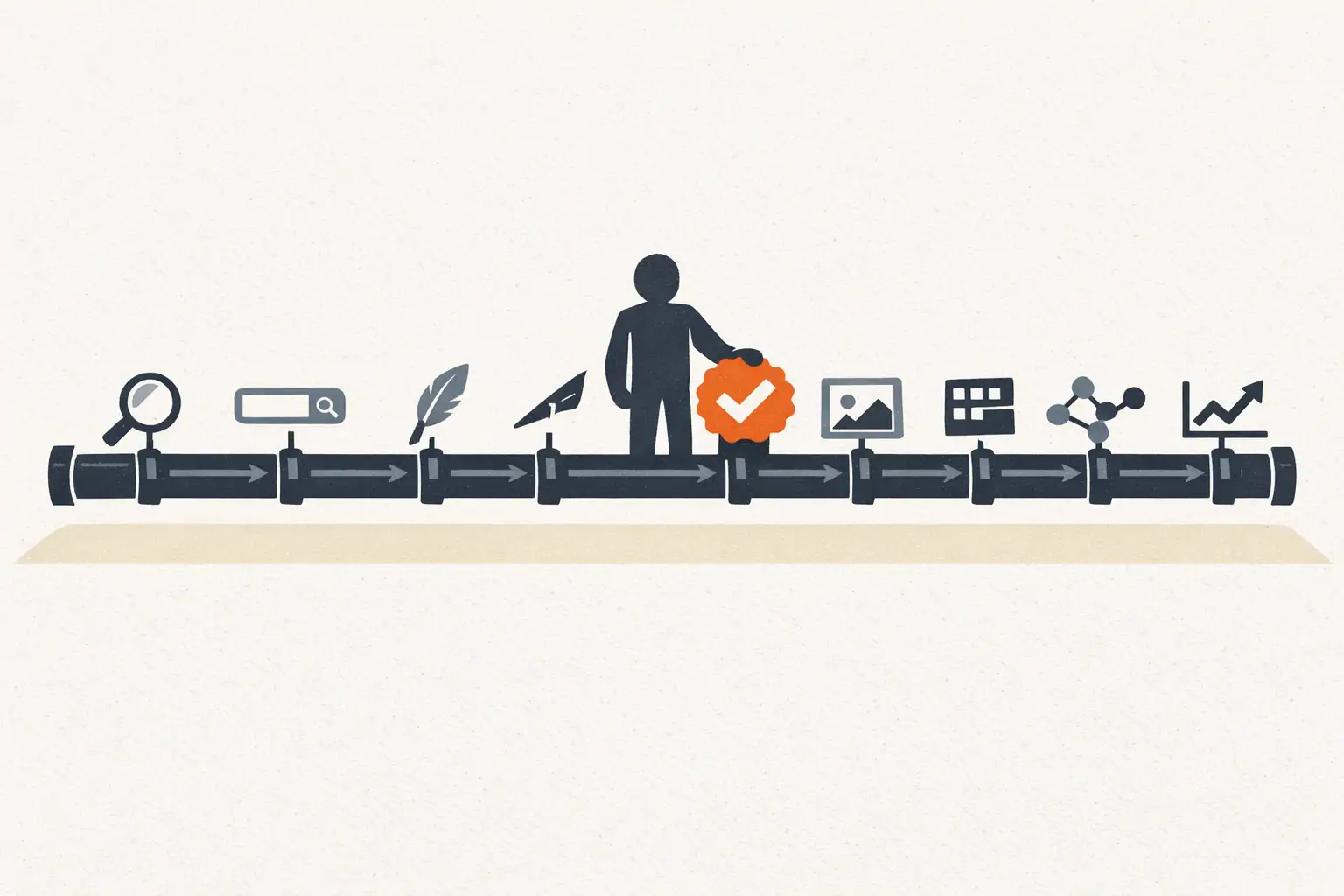
Most “SEO automation” content is written by people selling SEO automation software.
That’s a bad start because the incentives push the writing toward inflated claims. The truthful version of automated SEO in 2026 is less dramatic than the demos suggest, and more useful than the skeptics admit.
We’ve been running an automated SEO pipeline for the past month. A new domain, DR 0, zero prior content. We’ve shipped 25+ posts in that window using a workflow that pairs Claude for the research and drafting, Ahrefs for the keyword and SERP data, Keywords Everywhere as a backup signal, a markdown-to-WordPress publishing script, and a small set of mandatory review checkpoints that keep the output from being slop.
This post is the operator’s manual. The exact tools, the exact steps, the prompts we use, the checks that have to happen before anything publishes, and the things you should not try to automate.
For the broader stack context that this pipeline sits inside, our complete AI marketing stack post is the companion piece. For the team-shape question of who runs it, our 2-person AI marketing team post is the operating-model view.
What “SEO automation” actually means (and doesn’t)
Three things often get conflated under this label:
Programmatic SEO is generating thousands of pages from a structured data set. Used well: Zapier app pages, Yelp city pages, real estate listings. Used badly: thin doorway pages that Google quietly downranks. This is one specific pattern, not the whole category.
SEO tool automation is what most “SEO automation software” sells. Auto-audits, auto-redirects, auto-meta-description-generation, auto-internal-linking. Useful for hygiene, not for actually winning SERPs.
End-to-end content SEO automation is what this post covers: an AI-assisted pipeline from keyword research through publish, with humans at the review checkpoints that matter. This is where the compounding wins are if you do it right.
The third category is the one we run. The first two are real but narrower than the marketing makes them sound.
The honest problem with most automated SEO
A typical automated SEO setup fails for one of four reasons:
The keyword research is done from vibes, not data. The team picks topics that sound interesting and the AI dutifully writes them, but the keywords have either zero search volume or impossible competition for the site’s domain authority.
The drafts are published without a real review pass. The AI output is coherent, sometimes even pretty, and it goes live. Six months later the team wonders why nothing ranks and why the brand’s voice has quietly turned into beige.
The internal linking is ad hoc. Each new post is an island. The cluster never compounds, the topical authority never builds, and Google sees a pile of unrelated articles.
The measurement is theatrical. The team tracks vanity metrics (posts published, words written) instead of the things that actually predict ranking and revenue (search impressions, queries the site ranks for, clickthrough rate on positions 4-10).
The pipeline below addresses all four explicitly.
The pipeline, step by step
Seven steps. Each step has a tool, a prompt or workflow, and a review checkpoint. The whole thing can run start-to-finish in 90 minutes for a 2,000-word post once the pipeline is in place. The first post takes longer because you’re building the workflow.
Step 1: Keyword research with Claude + Ahrefs + Keywords Everywhere
The pipeline starts with a candidate keyword cluster, not a single keyword. We work in clusters because cluster-level topical authority is what compounds on a low-DR site.
The workflow:
- Give Claude the seed topic and the site’s domain authority (DR). Ask it to brainstorm 15-20 candidate keywords in the cluster.
- Pull each candidate’s volume, difficulty (KD), and CPC from Ahrefs Keywords Explorer. The API call we use returns keyword, volume, difficulty, and CPC in one shot.
- Cross-check the most promising candidates against Keywords Everywhere for a second volume signal. The two tools disagree often enough that the cross-check matters.
- For the top 2-3 candidates, pull the SERP overview from Ahrefs. We look at the DR and backlink count of the position 6-10 results. If the lowest-DR top-10 result is reachable from our current DR with strong content and internal links, the keyword is in play.
The rule we follow for ravitz.co at DR 0: target keywords with KD ≤ 20 and at least one top-10 result under DR 50. Sometimes we go higher on KD when the SERP has weak players we can displace. We did this on “seo automation” itself: KD 12, position 6 was a DR 40 site with 19 backlinks. Reachable.
The prompts we use for the research synthesis step are in our 30 ChatGPT prompts for marketers post.
Step 2: SERP validation and angle decision
The keyword research tells you what’s reachable. The SERP tells you what to write.
For each shortlisted keyword, we read the top 5 results and answer four questions:
- What is the dominant content type ranking? (Listicle, how-to, comparison, product page, video.)
- What’s the average length of the top 5?
- What three questions do all five answer well?
- What two questions does none of them answer?
The two questions nobody is answering are where the angle lives. Write the listicle the SERP wants, but include the two missing angles as your differentiators. That’s how a DR 0 site cracks into a SERP locked by DR 70+ sites.
For the gap-finding prompt we use here, our 30 ChatGPT prompts for marketers post has it as prompt #17.
Step 3: Article drafting with Claude
Now the actual writing. The drafting workflow:
- Give Claude the keyword, the SERP angle, the brand voice doc, and the existing internal-link inventory from the site.
- Ask for an outline first. Approve or revise the outline before any prose gets written.
- Draft the article section by section, not in one shot. Section-by-section lets the human reviewer catch drift early.
- Build in 8-14 internal links to existing posts during drafting, not as a post-process step. Each internal link reinforces the cluster.
- Build in 4+ external citations to authoritative sources. Internal-only posts read as walled gardens and hurt trust.
We use Claude for synthesis-heavy drafting and ChatGPT for shorter creative variants. The differences between them for marketing work are real but smaller than the discourse suggests. We compared them directly in our Claude vs ChatGPT for marketing post.
Step 4: The humanizer audit (mandatory)
This is the step most automated SEO pipelines skip, and it’s the step that determines whether the output gets cited by LLMs and trusted by readers or whether it reads as obvious AI slop.
Every draft runs through a humanizer audit pass. The audit checks for:
- Em dashes (cap: zero, or one per 500 words maximum)
- AI vocabulary tells (“delve,” “leverage,” “navigate the landscape,” “in today’s fast-paced world”)
- Pull-quote phrasing (sentences that sound like Instagram captions)
- Negative parallelisms (“It’s not just X. It’s Y.” patterns)
- Throat-clearing openers (“Here’s the thing:”, “Let me be clear:”)
- Rule-of-three forcing
- Metronomic paragraph endings
- Sycophantic tone
This pass takes 5-10 minutes per article and is the single highest-leverage edit we make. The drafts that go through it rank and get cited. The drafts that don’t read as AI slop and have to be rewritten anyway.
The agent-assisted version of this is one of the eight categories of AI agents for marketing we wrote about: a content-editing agent with a specific voice rubric attached.
Step 5: Image generation
Editorial images for every post. We use OpenAI’s image API (currently gpt-image-1.5) with single-scene prompts to avoid 45-second timeouts. The brand palette is locked: warm off-white background, deep graphite line work, signal orange accent, soft slate supporting elements, muted cream surface details.
Every image gets compressed to WebP at quality 90 before upload, which cuts file size by ~92% with no visible quality loss. The script that handles compression updates post.json paths automatically so the publish step uses the WebP version.
Every image, hero and content, must have descriptive alt text. We learned the hard way that the WordPress REST API doesn’t reliably set inline image alt text on first upload. We caught that script bug and fixed all 24 published posts in one retroactive pass.
Step 6: Publishing via the WordPress REST API
The publish step uses a Python script that:
- Reads
article.mdandpost.jsonfrom the post folder - Uploads images to the Media Library with correct alt text and titles
- Converts markdown to native Gutenberg block markup (paragraph, heading, list, quote, code, table blocks)
- Inserts content images after the specified H2 headings
- Resolves categories and tags (creates new ones if missing)
- Creates the post as a draft with Yoast SEO meta fields, focus keyword, and featured image
- Verifies the Yoast fields landed and prints them for manual paste if not
The whole publish step takes about 60 seconds per post. The result is a draft post in WordPress with everything pre-filled, ready for a final human review before publish.
The WordPress REST API documentation is the canonical reference if you’re building a similar script.
Step 7: Internal linking and cluster building
This is the step that produces compounding returns.
Every new post should:
- Link to 8-14 existing posts using descriptive anchor text (not “click here”)
- Get linked back from 2-4 existing posts where the new post adds value (we don’t retrofit every old post, just the ones where the new link is genuinely useful)
- Reinforce one specific topical cluster (we have three on ravitz.co right now)
- Use the focus keyword once in H1, once in the meta description, once in the first paragraph, and naturally throughout the body
The cluster pattern matters more than people think. HubSpot’s research on topic clusters and Ahrefs’ guide to topical authority both cover why. The short version: Google rewards sites that demonstrate depth on a topic, not breadth across topics.
Step 8: Measurement and iteration
The measurement layer closes the loop. Three things we track:
Search Console weekly. Which posts are showing up for which queries, at which positions, with what clickthrough rate. Position 4-10 queries are the highest-leverage targets: they’re a strong post away from page 1.
Ahrefs Brand Radar monthly. For LLM citations. We track when ChatGPT, Gemini, and Perplexity cite ravitz.co in their answers. This is a real-time signal of topical authority that pre-dates Google ranking gains by months.
Site-wide growth quarterly. Posts published, total impressions, ranking keywords, organic traffic. We compare quarter over quarter, not month over month, because SEO on a new domain takes 6-12 months to show real signal.
For the deeper measurement framework that catches the difference between time saved and revenue moved, our AI marketing ROI post is the companion read.
The compounding effect (what we’ve actually seen)
A few honest data points from the first month on ravitz.co:
The pipeline now produces a 2,000-2,500 word post end-to-end in 90 minutes once the keyword research has been done. The first post took 6+ hours because we were building the workflow at the same time.
Internal-link density has climbed from 2-3 internal links per post in week one to 10-14 internal links per post in week four. The cluster is starting to compound.
Search Console impressions are growing, though absolute volume is still small (this is a DR 0 site shipped a month ago). The ranking velocity on long-tail cluster keywords is faster than I would have predicted at this stage.
LLM citations have started appearing on Brand Radar. Small numbers, but the existence of any citations at all this early is the signal we cared about.
The compounding effects of an SEO automation pipeline aren’t visible in weeks one through four. The math reverses around month six. We’ll write the year-one retrospective when there’s a year of data, not before.
What to NOT automate
Four things we deliberately leave to humans:
Strategic keyword picking. Claude can shortlist candidates and pull the data, but the final call on which cluster to invest in is a human judgment that has to fit the consultancy’s positioning.
Voice calibration. Every post passes through a human edit. The humanizer audit catches the obvious slop; the human catches the subtler drift away from the brand’s actual point of view.
Fact-checking. Especially for posts with specific numbers, citations, or claims about how something works. AI is confidently wrong often enough that an unreviewed claim is a credibility risk.
The take. The strongest posts have a specific opinion that disagrees with the consensus. AI is bad at having a real take; it’s good at summarizing what other people have said. The opinion comes from the human, every time.
For the broader operating model that puts these checkpoints in the right place, our open-source AI agent safety post covers the permissions and review layer that any automated workflow needs.
The stack, summarized

The tools that make the pipeline work:
- Claude for keyword brainstorming, drafting, and synthesis
- Ahrefs for keyword data, SERP validation, and Brand Radar (LLM citation tracking)
- Keywords Everywhere for backup volume signals
- Google Search Console for ranking data
- OpenAI image API for editorial visuals
- WordPress REST API for publishing
- Yoast SEO for on-page optimization fields
- A small set of Python scripts to glue it all together
The total monthly tool cost is under $300. The time savings are 8-12 hours per post compared to the manual workflow this replaced. The output quality is better than the manual version because the humanizer audit and internal-link density rules are mandatory, not optional.
If your team wants help building a similar pipeline for your site, our services page explains how we work, and you can get in touch here.
FAQ
Can I run this pipeline without Ahrefs? Yes, with caveats. Ahrefs is the strongest single source for keyword data, SERP validation, and brand citation tracking, but you can substitute Semrush, Moz, or Ubersuggest for the keyword side. For LLM citation tracking specifically, Brand Radar is currently the cleanest tool we’ve used. The pipeline shape stays the same; the tools are swappable.
How long until I should expect to see rankings on a new domain? 6-12 months for competitive keywords. Sooner for long-tail cluster keywords with KD under 10. The teams that quit at month three because nothing ranks are quitting right before the compounding kicks in. The teams that keep shipping disciplined cluster content through month nine see the math reverse.
Should I publish AI-drafted posts without human review? No. The humanizer audit is the line between content that ranks and gets cited versus content that reads as AI slop and quietly damages the brand. The “AI ships 100 articles a week with zero human review” pitch is a credibility-erosion strategy disguised as productivity.
Can this whole pipeline run as an agent? Most of it, yes. The keyword research step, the SERP validation step, the drafting step, the image step, and the publish step are all good agent candidates. The humanizer audit and the take-calibration step should keep a human in the loop indefinitely. We covered the agent operating model in detail in our AI agents for marketing post.
What’s the single highest-leverage step in the pipeline? The humanizer audit. It’s a 5-10 minute step that determines whether the output is worth shipping. The teams that skip it ship faster and rank slower. The teams that run it religiously rank faster than the volume suggests they should.


