

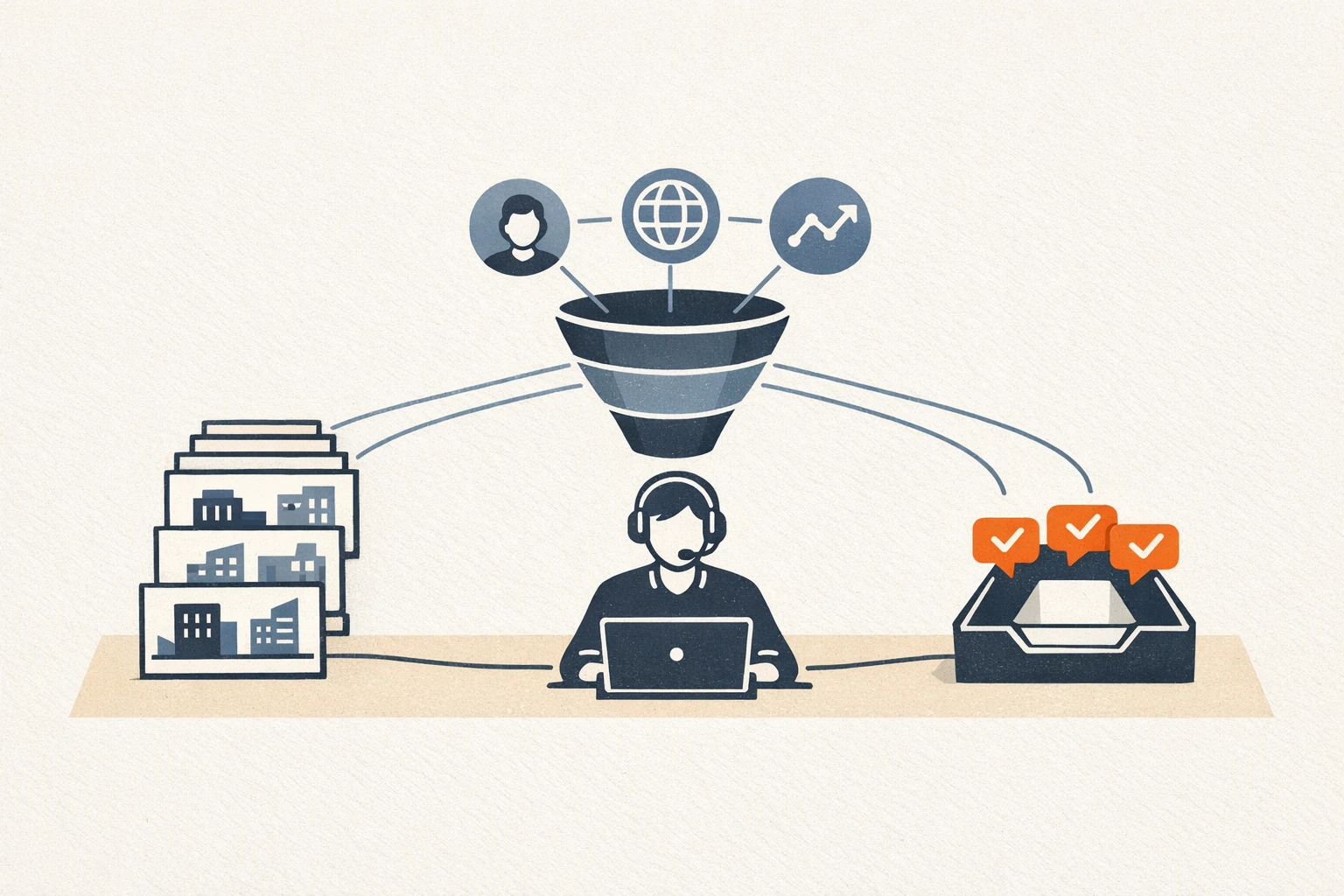
The pitch for AI in sales prospecting is everywhere: feed it your ICP, get a list of qualified leads, fire off personalized outreach at scale, watch the meetings book themselves.
The pitch works in demos. It works less well in inboxes.
What actually happens at most teams: rep buys an AI prospecting tool, blasts 500 “personalized” emails that all open with “I noticed your company is doing X” (because the AI inferred X from the LinkedIn headline), gets 1.2% reply rate, mostly negative, and quietly drops the tool after the trial.
The problem isn’t that AI for sales prospecting doesn’t work. It’s that most teams are using it to do the wrong job: scale bad outreach faster. The teams getting real lift are using it to do a different job: do better research and write fewer, better emails to higher-fit prospects.
This post is the working AI for sales prospecting workflow we recommend to clients. The research layer, the personalization layer that actually personalizes, the failure modes, and the specific reasons most AI sales tools produce worse pipeline than the manual version they replaced.
For the marketing-side workflows this connects to, our AI persona generator post covers the evidence-grounded ICP work that feeds prospecting, and our AI competitor analysis post covers the positioning research that shapes outreach.
What “AI for sales prospecting” actually means
Five distinct things get bundled under this label:
Lead list generation. AI builds a list of accounts and contacts matching your ICP. Tools like Apollo, ZoomInfo, and Clay lead this category.
Lead enrichment. AI fills in missing data on existing leads (firmographics, contact info, tech stack, recent triggers).
Lead scoring. AI ranks leads by likelihood-to-buy based on behavioral and firmographic signals.
Outreach personalization. AI drafts emails customized to specific prospects using their LinkedIn, company website, recent news, etc.
Outbound sequencing. AI manages multi-touch outreach campaigns across email, LinkedIn, and phone.
All five are legitimate use cases. They have different ROI profiles, different failure modes, and different “what to automate vs. what to keep human” calls. The mistake most teams make is treating “AI for sales prospecting” as one bucket and adopting all five at once.
The honest problem with most AI sales prospecting setups
Three patterns ruin most rollouts:
The tool replaces research with inference. AI tools infer “what your prospect cares about” from public signals (LinkedIn headline, latest tweet, blog post topic). The inferences sound personal but are actually generic. Recipients can tell instantly that they’re being pattern-matched, not understood.
The team scales output before validating the message. AI lets you send 10x more emails. If the message wasn’t working at 50/week, it definitely won’t work at 500/week, but now you’ve burned 500 inboxes’ worth of goodwill and trained your domain reputation toward spam.
The personalization is cosmetic. Most AI personalization just rewrites the opener: “Hi Sarah, I noticed [thing about Sarah’s company].” The body of the email, the offer, and the CTA are identical across 500 prospects. Cosmetic personalization on a generic message doesn’t outperform unpersonalized outreach by much.
A working AI sales prospecting workflow inverts all three. It uses AI for real research (not inference), validates message-market fit before scaling, and personalizes substantively (the offer, the proof point, the call-to-action), not just the opener.
The workflow we run
Seven steps. End-to-end takes about 90 minutes for a batch of 25 prospects once the workflow stabilizes. The first batch is slower because you’re building the workflow.
Step 1: define the ICP from real data, not vibes
Most prospecting goes wrong because the ICP is fictional. Before any tool gets involved, the team needs:
- 20+ closed-won customers as the training set
- Common firmographic patterns (size, industry, geography, tech stack)
- Common trigger events that preceded the buy (new VP marketing, layoffs in adjacent function, fundraise, product launch)
- The phrases customers used in win-calls (their language, not yours)
If you have closed-won data, run the AI persona generator workflow from our persona generator post on that data first. The output becomes the ICP definition.
If you don’t have closed-won data, skip AI prospecting entirely and run 20-50 manual conversations with target prospects first. AI accelerates pattern execution; it doesn’t manufacture patterns from nothing.
Step 2: build the target account list
Tools that work here: Apollo, ZoomInfo, Clay, LeadIQ. The free-form criteria they accept now (size + industry + tech stack + funding stage + headcount growth) make list-building 10x faster than three years ago.
The discipline is to keep the list small. Most teams build lists of 5,000 accounts and prospect 4,500 badly. Better: 200 accounts, prospect 50 well per week, measure response quality before scaling.
The right list size for a small team running this workflow: 100-300 target accounts at a time. Refresh the list quarterly.
Step 3: research the top accounts (AI-assisted, not AI-replaced)
For each target account, the research layer should answer:
- What did this company change recently? (Funding, layoffs, leadership, product launches, M&A)
- What problem does this company likely have that our solution addresses, based on public signals?
- Who is the actual buyer (job title + person)? Who is the influencer (job title + person)?
- What is this company’s stated positioning, and what does our solution support or contradict?
AI’s job in this step: pull and synthesize the public signals from LinkedIn, the company website, recent press, Crunchbase, Glassdoor, job postings, and earnings calls if public. Tools that do this well: Clay’s research enrichments, ZoomInfo’s intent signals, Cognism.
Human’s job in this step: read the AI synthesis, decide whether the prospect is worth pursuing, decide which angle to lead with. Skip the prospect if the research doesn’t reveal a credible reason to reach out.
Step 4: write the message (substantive personalization, not cosmetic)
The bad version of AI-generated outreach: “Hi [Name], I noticed [generic observation]. We help companies like yours [generic value prop]. Open to a 15-minute call?”
The good version: built from the research in step 3. The opener references a specific recent event. The body connects that event to a specific problem. The proof point is a specific result we’ve delivered for a similar company. The CTA is low-friction and asks for one specific thing.
Length: under 100 words. Most “AI personalized” outreach is 300+ words because the AI defaults to verbose. Cut it.
The prompt we use for outreach drafting is in our 30 ChatGPT prompts for marketers post, prompt #11. The version for sales swaps “draft a cold email” for “draft a sales outreach email for this account based on this research.”
Step 5: validate before scaling
Send the first 25 prospects manually. Track:
- Open rate (target 40%+ for cold outbound to be considered working)
- Reply rate (target 5%+ for cold, 10%+ for warm)
- Positive reply rate (target 50% of replies should be neutral-to-positive)
- Meeting booked rate (target 1-2% of total sends)
If the numbers aren’t there at 25 sends, don’t scale to 250. Iterate the message, the subject line, the segment, or the offer. Scale only when the math works at small volume.
The teams that skip this step burn through pipeline before they realize the message doesn’t work.
Step 6: scale the workflow (NOT the message)
Once a specific message-market combination is validated, scale it through:
- Multi-touch sequences (Outreach, Salesloft, Apollo sequences)
- Channel mix (email + LinkedIn + phone)
- A/B variants of the working message (not entirely new messages)
The mistake here is using “scale” to mean “send the same email to more people.” That just hits more inboxes. Real scaling means running the validated workflow against more high-fit accounts.
Step 7: measure and iterate
Weekly review of the prospecting funnel:
- Where are the drop-off points? (Open, reply, meeting set, meeting held, qualified)
- Which segment of the ICP is responding best?
- Which message variant is winning?
- Which trigger event correlates with highest response?
Feed the learnings back into step 1 (refine ICP) and step 4 (refine message). The compounding effect of AI for sales prospecting comes from the feedback loop, not from the tool.
For the broader operating model that pairs marketing and sales motion, our 2-person AI marketing team post covers what small teams can credibly run.
The honest tool stack
What we actually recommend for an AI for sales prospecting setup in 2026:
For list building and enrichment: Apollo for SMB pricing, ZoomInfo for enterprise, Clay if you want the most flexibility on data sources.
For research synthesis: Claude or ChatGPT against the data exports from your list-building tool. We use Claude for the multi-source synthesis step because it tends to push back on weak inferences.
For outreach drafting: Same as above. Use the prompts in our 30 ChatGPT prompts for marketers post.
For sequencing and send infrastructure: Outreach, Salesloft, or Apollo sequences. These are commodities now; pick what your team already uses.
For deliverability: Don’t skip this. AI-generated outbound at scale is the fastest way to destroy domain reputation. Smartlead and Instantly handle warmup, inbox rotation, and bounce management.
The full stack runs $200-$1,500/month depending on volume. Most of the spend is on list data, not on AI. The AI layer itself is the cheapest part of this stack in 2026.
Where AI for sales prospecting fails
Four predictable failure modes:
Personalization theater. The AI produces emails that sound personal but read as scripted. Recipients catch it instantly. Counter: substantive personalization based on real research, not inferred personalization based on public signals.
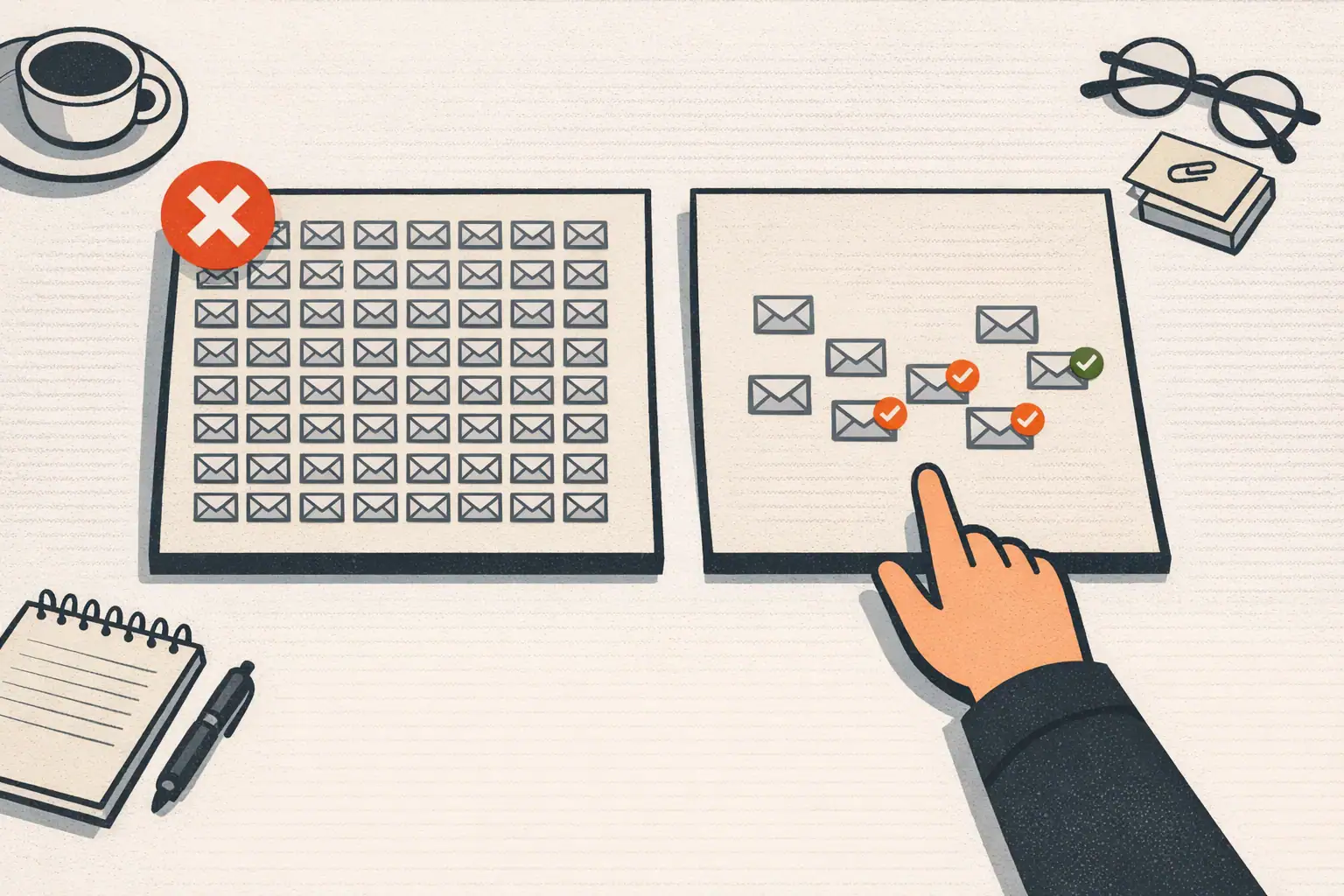
Volume substitution. Team sends 10x more because they can, instead of sending fewer better. Counter: validate at small volume, scale validated messages only.
ICP drift. AI tools default to widening the target list because their pricing rewards more contacts. Counter: discipline the list size. 200 well-fit accounts beats 5,000 mediocre ones.
Tool stacking without process. Team buys five tools, glues nothing together, runs nothing systematically. Counter: pick three tools, run the seven-step workflow, evaluate before adding a fourth.
For the broader pattern on what to actually automate vs. what to keep human in AI workflows, our open-source AI agent safety post covers the operating-model principles.
The 2026 deliverability problem
One thing that’s gotten meaningfully worse: the same AI tools that let you send “personalized” outreach at scale have flooded inboxes with low-quality outbound. Gmail’s and Outlook’s spam filters are now aggressively classifying AI-templated outbound as spam, even when the technical delivery is clean.
The teams winning at AI for sales prospecting in 2026 are the ones that look the least like AI-templated. Specifics: shorter emails, plain-text formatting, single-CTA, real human voice, fewer images, fewer links, sent at a cadence consistent with how a human would actually send.
Gmail’s 2026 bulk sender requirements (DMARC alignment, one-click unsubscribe, spam complaint rate under 0.3%) are the floor. The teams ignoring them are getting their domains burned out within weeks.
When AI for sales prospecting is NOT the right move
Three scenarios where we tell clients to skip the workflow:
- Brand new market or product (no closed-won data to build ICP from)
- High-ACV enterprise sales (1-1 strategic outreach beats automated outreach at this stage)
- Heavily regulated industries (healthcare, financial services) where personalization-at-scale creates compliance risk
In these cases, the team should run manual outbound until enough data exists to define a real ICP, or until the deal size justifies the level of customization AI can’t deliver.
If your team wants help building a working AI for sales prospecting workflow on your stack (or deciding whether you should), our services page explains how we work, and you can get in touch here.
FAQ
Can AI replace SDRs entirely? Not at any company doing real outbound. AI replaces the mechanical work an SDR does (list building, research synthesis, draft writing) but not the judgment work (which leads are worth pursuing, when to pivot the message, when to escalate). The teams trying to fully automate the SDR function end up with bad pipeline. The teams using AI to amplify SDR productivity are seeing 2-3x output per rep.
How many emails per week should one rep send with AI assistance? For high-quality outbound: 100-200/week per rep, not 1,000. The math is reply rate × meeting rate × meeting-to-opp rate × win rate. Sending 1,000 mediocre emails produces fewer opps than 100 well-researched ones, and burns the domain reputation in the process.
What about AI for inbound lead qualification? Adjacent problem, different workflow. AI for inbound is mostly about scoring and routing, not prospecting. Tools like Drift, Qualified, and HubSpot’s AI chatbot handle this well. The seven-step workflow above is specifically for outbound.
Should I write outreach with Claude or ChatGPT? We use Claude for the research synthesis step (better at multi-source synthesis with explicit reasoning) and ChatGPT for the variant generation step (better at producing 5-10 distinct subject line options, etc.). The two trade blows on the actual email draft. Try both, pick the one that produces output closer to your existing top-performing emails. We compared them in our Claude vs ChatGPT for marketing post.
Is AI for sales prospecting going to keep working as more people use it? The cosmetic-personalization version is already failing. The substantive-personalization version (real research, low volume, high relevance) should keep working indefinitely because it’s harder to commoditize. The teams that win at this category long-term are the ones who use AI to do better research, not faster spam.


