

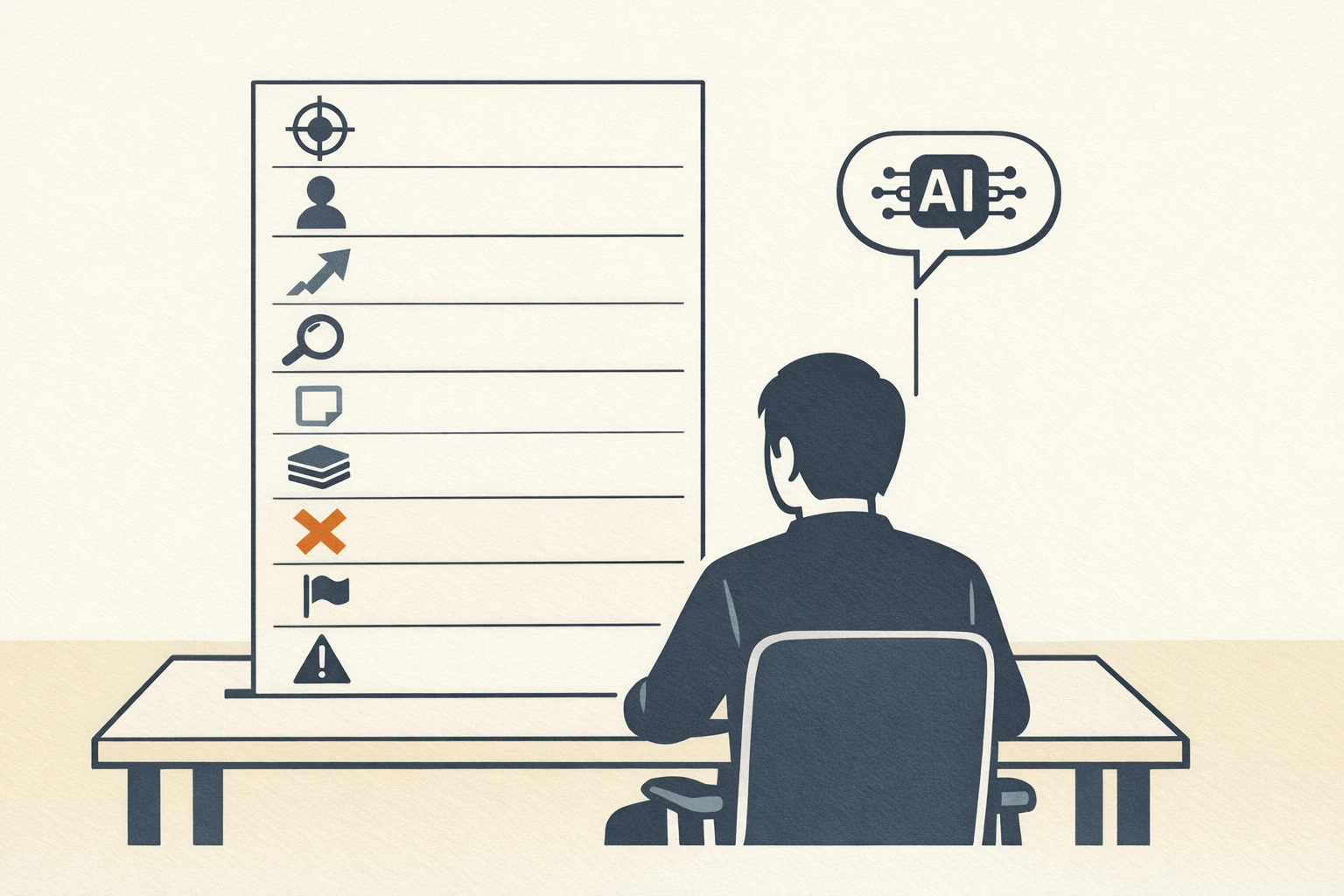
Most AI content briefs are too short to do any real work.
A typical bad brief: “Write a blog post about [topic]. Target keyword [X]. Make it 1,500 words. Match our brand voice.” The AI does its best with that and produces a draft that’s coherent, generic, and indistinguishable from every other piece of content on the internet about that topic.
The brief is doing the writing’s worst job: setting up failure. A working AI content brief looks more like the kind of brief an editor would write for a senior staff writer. It carries the strategy, the audience, the angle, the structure, the constraints, the proof points, the voice rules, and the failure modes to avoid.
This post is the AI content brief template we use on ravitz.co. The exact sections, why each one matters, the failure modes a thin brief produces, and the brief-as-prompt pattern that pairs the document with the AI workflow.
For the broader content stack this slots into, our AI content calendar post is the planning layer. For the prompts we run against briefs like this, our 30 ChatGPT prompts for marketers post is the companion library.
Why most content briefs produce generic AI output
Three patterns:
The brief is a topic, not a thesis. “Write about AI marketing.” That’s a topic. A thesis is “Most AI marketing software promises 10x productivity and delivers 10% because the bottleneck isn’t writing speed, it’s review and judgment.” The AI can build a piece around a thesis. It can only freelance around a topic, and freelancing means generic output.
The brief lacks audience specificity. “B2B marketers” is too broad. “Marketing leaders at 50-200 person B2B SaaS companies who run the function with one or two people” is specific. The AI’s voice and depth calibration depends on the audience description.
The brief doesn’t specify what to leave out. Briefs that only list what to cover end with bloated, table-stakes content. Briefs that explicitly say “do not cover X, Y, Z” produce sharper drafts.
A working AI content brief addresses all three. Below is the template.
The AI content brief template
Ten sections. Some are short. None are optional.
1. The thesis
One sentence. The argument the post is making, not the topic it’s covering.
Bad: “How to use AI for SEO.”
Good: “Most AI-for-SEO advice is written like SEO is dead and ChatGPT is the funeral, when the reality is that AI made certain SEO steps faster, certain steps worse, and added a new LLM-citation layer that didn’t exist two years ago.”
A thesis is arguable. A topic isn’t. The AI produces sharper writing when it’s building toward an argument than when it’s surveying a field.
2. The reader
Three things about the specific person reading this post:
- Their role and context (job title, company size, what they spend their day doing)
- The decision they’re trying to make right now
- What they already know about the topic (so we don’t over-explain or under-explain)
A reader description that fits 100,000 marketers is too broad. A reader description that fits 5,000 is right.
3. The angle
The specific take this post has that other ranking posts don’t take. From our SEO automation workflow: the angle comes from SERP analysis. What are the top 5 results saying, and what is none of them saying that the audience cares about?
The angle goes in the brief. The AI uses it to differentiate; without it, the AI defaults to consensus.
4. The target keyword + secondary terms
Focus keyword + 3-5 supporting terms. The AI weaves them into the draft naturally rather than forcing keyword stuffing. Pull these from real data: Ahrefs for volume and difficulty, Keywords Everywhere as a backup signal, Google Search Console for queries the site already half-ranks for.
5. The structure
H2/H3 outline. The AI is better at writing within a structure than at inventing one. If the brief lacks a structure, the AI defaults to a five-paragraph essay shape that doesn’t fit most content needs.
Specify:
- Working title (final title is decided after the draft)
- H2 sections in order
- H3 subsections under each H2
- Where to put diagrams, tables, code blocks, or callouts
- Target word count per section (not just total)
6. The proof points
The specific evidence the post should use:
- Customer quotes or anonymized examples
- Data points with sources
- Internal links to existing posts on the same domain
- External authoritative sources to cite
This is the section that turns a generic post into a credible one. The AI can synthesize; it can’t invent proof points the brief doesn’t provide.
For our own posts, we usually feed 8-14 internal-link candidates with descriptive anchor text suggestions, plus 4+ external citations from sources like Nielsen Norman Group, HubSpot’s marketing research, Anthropic, OpenAI, Google, or category-specific authoritative sources.
7. The voice rules
A brief without voice rules produces drafts in default-AI register: confident, slightly louder than necessary, generic. The voice rules section pulls the AI toward your brand’s actual tone.
Concrete rules we include in every brief:
- Em dashes: zero (or one per 500 words maximum)
- AI vocabulary to avoid: “delve,” “leverage,” “navigate the landscape,” “in today’s fast-paced world,” “harness the power of”
- Sentence rhythm: vary length, no metronomic patterns
- Negative parallelisms: avoid “Not just X. It’s Y.” constructions
- Throat-clearing openers: no “Here’s the thing,” “Let me be clear,” “The reality is”
- Rule of three: don’t force three when the idea fits two or four
- Pull-quote phrasing: rewrite anything that sounds like an Instagram caption
The full humanizer audit pattern is in our SEO automation post.
8. What to leave out
The under-used section that makes the biggest quality difference. Examples from briefs we’ve used:
- “Don’t cover the history of [topic]. Reader already knows it.”
- “Don’t include a definition of [term]. Audience uses it daily.”
- “Don’t list every alternative tool. We’re focused on three: X, Y, Z.”
- “Don’t conclude with ‘the future is bright.’ Conclude with a specific recommendation.”
Briefs without this section produce drafts that include everything plausibly related, which is the opposite of what makes content worth reading.
9. The success metric
What does this post need to do? Three options usually fit:
- Rank for [keyword] in 6-12 months
- Get cited by ChatGPT/Claude/Perplexity for [query]
- Convert [traffic source] into [next action]
The success metric shapes the tone, depth, and CTA. A post optimized for LLM citation reads differently from a post optimized for Google ranking, which reads differently from a sales-enablement post.
10. The failure modes to avoid
What does a bad draft look like? Specifying this explicitly catches the most common AI failure patterns before they show up in the output.
Examples:
- “Bad version: generic ‘here’s what AI can do’ post that lists capabilities without specific workflows.”
- “Bad version: case study that praises the brand without showing the system that produced the results.”
- “Bad version: technical-explainer that gets lost in implementation details before the reader knows why they care.”
The AI uses this section to self-correct during drafting.
What the full template looks like in practice
The complete brief for the our SEO automation post was roughly:
- Thesis: Most “SEO automation” content is written by people selling SEO automation software, which produces inflated claims; the truthful version is less dramatic and more useful.
- Reader: Marketing leaders or operators at small B2B teams (1-5 people) running the function in-house, evaluating whether AI-assisted SEO is worth investing in.
- Angle: Document the actual end-to-end pipeline we’ve run on ravitz.co for 25+ posts. Operator-authentic, not vendor-pitch.
- Target keyword: seo automation (vol 2,600, KD 12)
- Structure: 7 numbered steps from keyword research through measurement, with H3 per step.
- Proof points: Actual data from ravitz.co (DR 0, 28 posts, time-per-post numbers). 11 internal links to existing posts. External cites to Ahrefs, Search Console, NIST, Google Search Central, etc.
- Voice rules: standard humanizer audit (zero em dashes, no AI vocabulary, etc.)
- Leave out: Generic AI hype. Vendor product comparisons. Theoretical frameworks without specific steps.
- Success metric: Rank for “seo automation” in top 10 within 6 months; get cited by Claude and ChatGPT for “how to automate SEO” queries.
- Failure modes: Reads like an SEO software pitch. Hand-waves on specifics. Sounds confident but doesn’t show the actual workflow.
That brief produced the draft in roughly 30 minutes once the keyword research was done. The brief is the work. The drafting is mechanical once the brief is right.
How to use the brief with AI

Three patterns for pairing the brief with the AI workflow:
Single-shot. Paste the full brief into Claude or ChatGPT along with the prompt “Write the full post per this brief.” Works for shorter pieces (under 1,500 words) or when the writer already has a strong voice instinct that catches drift in editing.
Section-by-section. Have the AI draft each H2 separately, with the brief at the top of each prompt. Lets the human reviewer catch direction errors early. We default to this pattern for posts over 2,000 words.
Outline-first, then draft. Have the AI draft an outline from the brief, edit the outline, then draft sections from the approved outline. Slowest but produces the strongest pieces. Worth it for pillar content.
For the broader operating model that decides which pattern to use for which post, our 2-person AI marketing team post covers what one or two operators can sustainably run.
The mistakes that ruin AI content briefs
Four patterns we keep watching:
The brief is a checklist instead of a thesis. “Cover X, Y, Z.” That’s not a brief, it’s an outline. A brief argues for a specific take and instructs the writer on how to defend it.
Voice rules are missing. Without explicit voice rules, the AI’s default register leaks into the draft. The humanizer audit catches it on the back end, but a brief with voice rules upfront produces less to clean up.
No “leave out” section. Bloated drafts come from briefs that only specify inclusion. The discipline is naming what doesn’t belong.
No success metric. Briefs without a stated goal produce drafts that hedge between objectives. A post can be optimized for ranking, citation, or conversion, but trying to do all three usually means it does none well. We covered the broader measurement pattern in our AI marketing ROI post.
The brief as a reusable asset
A good brief is a one-time investment that pays off across multiple uses:
- Drafting the original post (the obvious use)
- Drafting follow-up posts in the same cluster (most sections carry forward)
- Briefing freelancers or new team members (the document is the onboarding)
- Reviewing the AI draft against the brief (audit, not just edit)
The teams that treat briefs as throwaway prompts re-do the strategic work every time. The teams that treat briefs as reusable assets compound the strategic work across the cluster.
If your team wants help building an AI content brief library that scales across your content program, our services page explains how we work, and you can get in touch here.
FAQ
How long should an AI content brief be? For a 2,000-word post, the brief is usually 600-1,000 words. Shorter briefs produce thinner drafts. Briefs over 1,500 words are usually a sign the strategic work is being done in the brief instead of in the planning that should precede it. Aim for the brief to be roughly 1/3 the length of the target draft.
Should I use a template or write each brief from scratch? Template. The ten sections above stay constant; only the content inside each section changes per post. The teams that write from scratch every time spend more time on briefs than necessary. The template forces consistency, which compounds across the cluster.
Can I generate the brief itself with AI? Partially. The AI can draft a brief from a topic, but the strategic decisions (thesis, angle, what to leave out) should come from a human who knows the audience and the business goals. The AI’s brief-from-topic output is a starting point, not the final brief.
Do I need to write a brief for every blog post? Yes for anything you actually want to rank or get cited. The exceptions are very short utility posts (announcements, simple how-tos under 500 words) where the strategy doesn’t need to be defended. For 1,500+ word pieces, skipping the brief produces consistently weaker drafts.
What’s the single most important section of the brief? The thesis. Everything else flows from it. A brief with a sharp thesis and weak sections elsewhere still produces a usable draft. A brief with a weak thesis and strong sections elsewhere produces well-organized generic content that nobody remembers reading.


